US7790698B2 - Use of adenosine receptor agonists in therapy - Google Patents
Use of adenosine receptor agonists in therapy Download PDFInfo
- Publication number
- US7790698B2 US7790698B2 US10/547,454 US54745406A US7790698B2 US 7790698 B2 US7790698 B2 US 7790698B2 US 54745406 A US54745406 A US 54745406A US 7790698 B2 US7790698 B2 US 7790698B2
- Authority
- US
- United States
- Prior art keywords
- compound
- administered
- methoxyadenosine
- adenosine
- formula
- Prior art date
- Legal status (The legal status is an assumption and is not a legal conclusion. Google has not performed a legal analysis and makes no representation as to the accuracy of the status listed.)
- Expired - Fee Related
Links
- 239000003379 purinergic P1 receptor agonist Substances 0.000 title description 7
- 238000002560 therapeutic procedure Methods 0.000 title description 2
- 150000001875 compounds Chemical class 0.000 claims abstract description 80
- 230000036470 plasma concentration Effects 0.000 claims abstract description 23
- 238000000034 method Methods 0.000 claims abstract description 16
- 108050000203 Adenosine receptors Proteins 0.000 claims abstract description 14
- 102000009346 Adenosine receptors Human genes 0.000 claims abstract description 13
- 206010061218 Inflammation Diseases 0.000 claims abstract description 11
- 230000004054 inflammatory process Effects 0.000 claims abstract description 11
- 125000000229 (C1-C4)alkoxy group Chemical group 0.000 claims abstract description 4
- AJACDNCVEGIBNA-KQYNXXCUSA-N (2r,3r,4s,5r)-2-(6-amino-2-methoxypurin-9-yl)-5-(hydroxymethyl)oxolane-3,4-diol Chemical compound C12=NC(OC)=NC(N)=C2N=CN1[C@@H]1O[C@H](CO)[C@@H](O)[C@H]1O AJACDNCVEGIBNA-KQYNXXCUSA-N 0.000 claims description 24
- AJACDNCVEGIBNA-UHFFFAOYSA-N 2-Methoxyadenosine Natural products C12=NC(OC)=NC(N)=C2N=CN1C1OC(CO)C(O)C1O AJACDNCVEGIBNA-UHFFFAOYSA-N 0.000 claims description 24
- 230000000694 effects Effects 0.000 claims description 24
- 208000001953 Hypotension Diseases 0.000 claims description 4
- 230000036471 bradycardia Effects 0.000 claims description 4
- 208000006218 bradycardia Diseases 0.000 claims description 4
- RROANHICBKIZLM-QYVSTXNMSA-N (2r,3r,4s,5r)-2-(6-amino-2-butoxypurin-9-yl)-5-(hydroxymethyl)oxolane-3,4-diol Chemical compound C12=NC(OCCCC)=NC(N)=C2N=CN1[C@@H]1O[C@H](CO)[C@@H](O)[C@H]1O RROANHICBKIZLM-QYVSTXNMSA-N 0.000 claims description 3
- NFMJXEMKAVCGPF-IOSLPCCCSA-N (2r,3r,4s,5r)-2-(6-amino-2-ethoxypurin-9-yl)-5-(hydroxymethyl)oxolane-3,4-diol Chemical compound C12=NC(OCC)=NC(N)=C2N=CN1[C@@H]1O[C@H](CO)[C@@H](O)[C@H]1O NFMJXEMKAVCGPF-IOSLPCCCSA-N 0.000 claims description 3
- OTGLIOGMYXAQCM-IGJMFERPSA-N (2r,3r,5s)-2-(6-amino-2-butoxypurin-9-yl)-5-(hydroxymethyl)oxolan-3-ol Chemical compound C12=NC(OCCCC)=NC(N)=C2N=CN1[C@@H]1O[C@H](CO)C[C@H]1O OTGLIOGMYXAQCM-IGJMFERPSA-N 0.000 claims description 3
- XRUUDWLHUPCHFM-JOAULVNJSA-N (2r,3r,5s)-2-(6-amino-2-propan-2-yloxypurin-9-yl)-5-(hydroxymethyl)oxolan-3-ol Chemical compound C12=NC(OC(C)C)=NC(N)=C2N=CN1[C@@H]1O[C@H](CO)C[C@H]1O XRUUDWLHUPCHFM-JOAULVNJSA-N 0.000 claims description 3
- UQBODDSTMCWQAO-JOAULVNJSA-N (2r,3r,5s)-2-(6-amino-2-propoxypurin-9-yl)-5-(hydroxymethyl)oxolan-3-ol Chemical compound C12=NC(OCCC)=NC(N)=C2N=CN1[C@@H]1O[C@H](CO)C[C@H]1O UQBODDSTMCWQAO-JOAULVNJSA-N 0.000 claims description 3
- 208000001871 Tachycardia Diseases 0.000 claims description 3
- 230000036543 hypotension Effects 0.000 claims description 3
- 230000006794 tachycardia Effects 0.000 claims description 3
- 150000003839 salts Chemical class 0.000 claims 7
- 230000002265 prevention Effects 0.000 abstract description 9
- 150000003838 adenosines Chemical class 0.000 abstract 1
- 208000037265 diseases, disorders, signs and symptoms Diseases 0.000 abstract 1
- 208000035475 disorder Diseases 0.000 abstract 1
- OIRDTQYFTABQOQ-KQYNXXCUSA-N adenosine Chemical compound C1=NC=2C(N)=NC=NC=2N1[C@@H]1O[C@H](CO)[C@@H](O)[C@H]1O OIRDTQYFTABQOQ-KQYNXXCUSA-N 0.000 description 22
- 102000005962 receptors Human genes 0.000 description 16
- 108020003175 receptors Proteins 0.000 description 16
- 239000002126 C01EB10 - Adenosine Substances 0.000 description 11
- 229960005305 adenosine Drugs 0.000 description 11
- 230000036772 blood pressure Effects 0.000 description 10
- 230000003110 anti-inflammatory effect Effects 0.000 description 7
- 229920001525 carrageenan Polymers 0.000 description 7
- 239000003814 drug Substances 0.000 description 7
- 208000007101 Muscle Cramp Diseases 0.000 description 6
- 206010028980 Neoplasm Diseases 0.000 description 5
- 241000700159 Rattus Species 0.000 description 5
- 206010063837 Reperfusion injury Diseases 0.000 description 5
- 206010040070 Septic Shock Diseases 0.000 description 5
- 239000013543 active substance Substances 0.000 description 5
- 230000002411 adverse Effects 0.000 description 5
- 201000011510 cancer Diseases 0.000 description 5
- 239000000679 carrageenan Substances 0.000 description 5
- 229940113118 carrageenan Drugs 0.000 description 5
- 235000010418 carrageenan Nutrition 0.000 description 5
- 210000001519 tissue Anatomy 0.000 description 5
- UHVMMEOXYDMDKI-JKYCWFKZSA-L zinc;1-(5-cyanopyridin-2-yl)-3-[(1s,2s)-2-(6-fluoro-2-hydroxy-3-propanoylphenyl)cyclopropyl]urea;diacetate Chemical compound [Zn+2].CC([O-])=O.CC([O-])=O.CCC(=O)C1=CC=C(F)C([C@H]2[C@H](C2)NC(=O)NC=2N=CC(=CC=2)C#N)=C1O UHVMMEOXYDMDKI-JKYCWFKZSA-L 0.000 description 5
- 0 *C1=NC2=C(N=CN2[C@]2([H])O[C@]([H])(CO)C([H])(C)[C@]2([H])O)C(N)=N1 Chemical compound *C1=NC2=C(N=CN2[C@]2([H])O[C@]([H])(CO)C([H])(C)[C@]2([H])O)C(N)=N1 0.000 description 4
- 241001465754 Metazoa Species 0.000 description 4
- 206010040047 Sepsis Diseases 0.000 description 4
- 210000004027 cell Anatomy 0.000 description 4
- 206010015037 epilepsy Diseases 0.000 description 4
- CGIGDMFJXJATDK-UHFFFAOYSA-N indomethacin Chemical compound CC1=C(CC(O)=O)C2=CC(OC)=CC=C2N1C(=O)C1=CC=C(Cl)C=C1 CGIGDMFJXJATDK-UHFFFAOYSA-N 0.000 description 4
- 230000002829 reductive effect Effects 0.000 description 4
- 230000004044 response Effects 0.000 description 4
- 101150007969 ADORA1 gene Proteins 0.000 description 3
- 102000007471 Adenosine A2A receptor Human genes 0.000 description 3
- 108010085277 Adenosine A2A receptor Proteins 0.000 description 3
- 208000024827 Alzheimer disease Diseases 0.000 description 3
- 208000023275 Autoimmune disease Diseases 0.000 description 3
- 206010006895 Cachexia Diseases 0.000 description 3
- 206010049565 Muscle fatigue Diseases 0.000 description 3
- 239000000556 agonist Substances 0.000 description 3
- 206010003246 arthritis Diseases 0.000 description 3
- 239000003085 diluting agent Substances 0.000 description 3
- 229940079593 drug Drugs 0.000 description 3
- 230000005764 inhibitory process Effects 0.000 description 3
- 208000012947 ischemia reperfusion injury Diseases 0.000 description 3
- 238000004519 manufacturing process Methods 0.000 description 3
- 230000004770 neurodegeneration Effects 0.000 description 3
- 239000000018 receptor agonist Substances 0.000 description 3
- 229940044601 receptor agonist Drugs 0.000 description 3
- 230000009467 reduction Effects 0.000 description 3
- 230000036303 septic shock Effects 0.000 description 3
- ZOIRPYWRWZORFZ-WOUKDFQISA-N (2r,3r,4s,5r)-2-(6-amino-2-propan-2-yloxypurin-9-yl)-5-(hydroxymethyl)oxolane-3,4-diol Chemical compound C12=NC(OC(C)C)=NC(N)=C2N=CN1[C@@H]1O[C@H](CO)[C@@H](O)[C@H]1O ZOIRPYWRWZORFZ-WOUKDFQISA-N 0.000 description 2
- BOHZYKDFAJFENY-WOUKDFQISA-N (2r,3r,4s,5r)-2-(6-amino-2-propoxypurin-9-yl)-5-(hydroxymethyl)oxolane-3,4-diol Chemical compound C12=NC(OCCC)=NC(N)=C2N=CN1[C@@H]1O[C@H](CO)[C@@H](O)[C@H]1O BOHZYKDFAJFENY-WOUKDFQISA-N 0.000 description 2
- LDMQLKHJPRJETI-MVKOHCKWSA-N (2r,3r,5s)-2-(6-amino-2-ethoxypurin-9-yl)-5-(hydroxymethyl)oxolan-3-ol Chemical compound C12=NC(OCC)=NC(N)=C2N=CN1[C@@H]1O[C@H](CO)C[C@H]1O LDMQLKHJPRJETI-MVKOHCKWSA-N 0.000 description 2
- HIZCDECDIFPLJG-BAJZRUMYSA-N (2r,3r,5s)-2-(6-amino-2-methoxypurin-9-yl)-5-(hydroxymethyl)oxolan-3-ol Chemical compound C12=NC(OC)=NC(N)=C2N=CN1[C@@H]1O[C@H](CO)C[C@H]1O HIZCDECDIFPLJG-BAJZRUMYSA-N 0.000 description 2
- 101150046889 ADORA3 gene Proteins 0.000 description 2
- 208000030507 AIDS Diseases 0.000 description 2
- 206010001513 AIDS related complex Diseases 0.000 description 2
- 101150051188 Adora2a gene Proteins 0.000 description 2
- 206010063094 Cerebral malaria Diseases 0.000 description 2
- UGJMXCAKCUNAIE-UHFFFAOYSA-N Gabapentin Chemical compound OC(=O)CC1(CN)CCCCC1 UGJMXCAKCUNAIE-UHFFFAOYSA-N 0.000 description 2
- 201000004681 Psoriasis Diseases 0.000 description 2
- 210000000683 abdominal cavity Anatomy 0.000 description 2
- 229940035676 analgesics Drugs 0.000 description 2
- 239000000730 antalgic agent Substances 0.000 description 2
- 208000006673 asthma Diseases 0.000 description 2
- 230000008901 benefit Effects 0.000 description 2
- 229930003827 cannabinoid Natural products 0.000 description 2
- 239000003557 cannabinoid Substances 0.000 description 2
- 229940065144 cannabinoids Drugs 0.000 description 2
- 210000000170 cell membrane Anatomy 0.000 description 2
- 230000008859 change Effects 0.000 description 2
- 230000006378 damage Effects 0.000 description 2
- 210000002683 foot Anatomy 0.000 description 2
- 229960000905 indomethacin Drugs 0.000 description 2
- 208000015181 infectious disease Diseases 0.000 description 2
- 208000027866 inflammatory disease Diseases 0.000 description 2
- 230000002757 inflammatory effect Effects 0.000 description 2
- 208000002551 irritable bowel syndrome Diseases 0.000 description 2
- 230000001404 mediated effect Effects 0.000 description 2
- 239000000203 mixture Substances 0.000 description 2
- 201000006417 multiple sclerosis Diseases 0.000 description 2
- 210000000056 organ Anatomy 0.000 description 2
- 201000008482 osteoarthritis Diseases 0.000 description 2
- 239000000546 pharmaceutical excipient Substances 0.000 description 2
- 230000002685 pulmonary effect Effects 0.000 description 2
- 206010039073 rheumatoid arthritis Diseases 0.000 description 2
- 239000012266 salt solution Substances 0.000 description 2
- 241000894007 species Species 0.000 description 2
- 208000011580 syndromic disease Diseases 0.000 description 2
- 230000001225 therapeutic effect Effects 0.000 description 2
- NGSRMSVXLUMDAX-KQYNXXCUSA-N 6-amino-9-[(2r,3r,4s,5r)-3,4-dihydroxy-5-(hydroxymethyl)oxolan-2-yl]-1-methylpurin-2-one Chemical class C12=NC(=O)N(C)C(N)=C2N=CN1[C@@H]1O[C@H](CO)[C@@H](O)[C@H]1O NGSRMSVXLUMDAX-KQYNXXCUSA-N 0.000 description 1
- 206010001052 Acute respiratory distress syndrome Diseases 0.000 description 1
- 108010060263 Adenosine A1 Receptor Proteins 0.000 description 1
- 102000030814 Adenosine A1 receptor Human genes 0.000 description 1
- APKFDSVGJQXUKY-KKGHZKTASA-N Amphotericin-B Natural products O[C@H]1[C@@H](N)[C@H](O)[C@@H](C)O[C@H]1O[C@H]1C=CC=CC=CC=CC=CC=CC=C[C@H](C)[C@@H](O)[C@@H](C)[C@H](C)OC(=O)C[C@H](O)C[C@H](O)CC[C@@H](O)[C@H](O)C[C@H](O)C[C@](O)(C[C@H](O)[C@H]2C(O)=O)O[C@H]2C1 APKFDSVGJQXUKY-KKGHZKTASA-N 0.000 description 1
- 206010002556 Ankylosing Spondylitis Diseases 0.000 description 1
- 101800004538 Bradykinin Proteins 0.000 description 1
- PAOANWZGLPPROA-RQXXJAGISA-N CGS-21680 Chemical compound O[C@@H]1[C@H](O)[C@@H](C(=O)NCC)O[C@H]1N1C2=NC(NCCC=3C=CC(CCC(O)=O)=CC=3)=NC(N)=C2N=C1 PAOANWZGLPPROA-RQXXJAGISA-N 0.000 description 1
- 108090000312 Calcium Channels Proteins 0.000 description 1
- 102000003922 Calcium Channels Human genes 0.000 description 1
- 206010008089 Cerebral artery occlusion Diseases 0.000 description 1
- 208000006545 Chronic Obstructive Pulmonary Disease Diseases 0.000 description 1
- 206010009900 Colitis ulcerative Diseases 0.000 description 1
- 206010011086 Coronary artery occlusion Diseases 0.000 description 1
- 208000011231 Crohn disease Diseases 0.000 description 1
- 206010014824 Endotoxic shock Diseases 0.000 description 1
- 206010016654 Fibrosis Diseases 0.000 description 1
- WQZGKKKJIJFFOK-GASJEMHNSA-N Glucose Natural products OC[C@H]1OC(O)[C@H](O)[C@@H](O)[C@@H]1O WQZGKKKJIJFFOK-GASJEMHNSA-N 0.000 description 1
- 201000005569 Gout Diseases 0.000 description 1
- 206010018634 Gouty Arthritis Diseases 0.000 description 1
- 108010017213 Granulocyte-Macrophage Colony-Stimulating Factor Proteins 0.000 description 1
- 102100039620 Granulocyte-macrophage colony-stimulating factor Human genes 0.000 description 1
- QXZGBUJJYSLZLT-UHFFFAOYSA-N H-Arg-Pro-Pro-Gly-Phe-Ser-Pro-Phe-Arg-OH Natural products NC(N)=NCCCC(N)C(=O)N1CCCC1C(=O)N1C(C(=O)NCC(=O)NC(CC=2C=CC=CC=2)C(=O)NC(CO)C(=O)N2C(CCC2)C(=O)NC(CC=2C=CC=CC=2)C(=O)NC(CCCN=C(N)N)C(O)=O)CCC1 QXZGBUJJYSLZLT-UHFFFAOYSA-N 0.000 description 1
- 208000032456 Hemorrhagic Shock Diseases 0.000 description 1
- DGAQECJNVWCQMB-PUAWFVPOSA-M Ilexoside XXIX Chemical compound C[C@@H]1CC[C@@]2(CC[C@@]3(C(=CC[C@H]4[C@]3(CC[C@@H]5[C@@]4(CC[C@@H](C5(C)C)OS(=O)(=O)[O-])C)C)[C@@H]2[C@]1(C)O)C)C(=O)O[C@H]6[C@@H]([C@H]([C@@H]([C@H](O6)CO)O)O)O.[Na+] DGAQECJNVWCQMB-PUAWFVPOSA-M 0.000 description 1
- 102100020873 Interleukin-2 Human genes 0.000 description 1
- 108010002350 Interleukin-2 Proteins 0.000 description 1
- 102100035792 Kininogen-1 Human genes 0.000 description 1
- GUBGYTABKSRVRQ-QKKXKWKRSA-N Lactose Natural products OC[C@H]1O[C@@H](O[C@H]2[C@H](O)[C@@H](O)C(O)O[C@@H]2CO)[C@H](O)[C@@H](O)[C@H]1O GUBGYTABKSRVRQ-QKKXKWKRSA-N 0.000 description 1
- 206010027202 Meningitis bacterial Diseases 0.000 description 1
- 208000000112 Myalgia Diseases 0.000 description 1
- 206010030113 Oedema Diseases 0.000 description 1
- 208000001132 Osteoporosis Diseases 0.000 description 1
- 206010037660 Pyrexia Diseases 0.000 description 1
- 206010048988 Renal artery occlusion Diseases 0.000 description 1
- 208000013616 Respiratory Distress Syndrome Diseases 0.000 description 1
- 241000283984 Rodentia Species 0.000 description 1
- 206010049771 Shock haemorrhagic Diseases 0.000 description 1
- 201000010001 Silicosis Diseases 0.000 description 1
- 108010052164 Sodium Channels Proteins 0.000 description 1
- 102000018674 Sodium Channels Human genes 0.000 description 1
- 208000003734 Supraventricular Tachycardia Diseases 0.000 description 1
- 102000003141 Tachykinin Human genes 0.000 description 1
- 206010044248 Toxic shock syndrome Diseases 0.000 description 1
- 231100000650 Toxic shock syndrome Toxicity 0.000 description 1
- 206010052779 Transplant rejections Diseases 0.000 description 1
- 201000006704 Ulcerative Colitis Diseases 0.000 description 1
- 230000009471 action Effects 0.000 description 1
- 239000002582 adenosine A1 receptor agonist Substances 0.000 description 1
- 239000002465 adenosine A2a receptor agonist Substances 0.000 description 1
- 150000003835 adenosine derivatives Chemical class 0.000 description 1
- 208000011341 adult acute respiratory distress syndrome Diseases 0.000 description 1
- 201000000028 adult respiratory distress syndrome Diseases 0.000 description 1
- 125000000217 alkyl group Chemical group 0.000 description 1
- APKFDSVGJQXUKY-INPOYWNPSA-N amphotericin B Chemical compound O[C@H]1[C@@H](N)[C@H](O)[C@@H](C)O[C@H]1O[C@H]1/C=C/C=C/C=C/C=C/C=C/C=C/C=C/[C@H](C)[C@@H](O)[C@@H](C)[C@H](C)OC(=O)C[C@H](O)C[C@H](O)CC[C@@H](O)[C@H](O)C[C@H](O)C[C@](O)(C[C@H](O)[C@H]2C(O)=O)O[C@H]2C1 APKFDSVGJQXUKY-INPOYWNPSA-N 0.000 description 1
- 229960003942 amphotericin b Drugs 0.000 description 1
- 238000010171 animal model Methods 0.000 description 1
- 230000001430 anti-depressive effect Effects 0.000 description 1
- 230000003556 anti-epileptic effect Effects 0.000 description 1
- 230000003070 anti-hyperalgesia Effects 0.000 description 1
- 230000003276 anti-hypertensive effect Effects 0.000 description 1
- 229940121363 anti-inflammatory agent Drugs 0.000 description 1
- 239000002260 anti-inflammatory agent Substances 0.000 description 1
- 239000001961 anticonvulsive agent Substances 0.000 description 1
- 239000000935 antidepressant agent Substances 0.000 description 1
- 229940005513 antidepressants Drugs 0.000 description 1
- 229960003965 antiepileptics Drugs 0.000 description 1
- 210000000702 aorta abdominal Anatomy 0.000 description 1
- 230000002917 arthritic effect Effects 0.000 description 1
- QVGXLLKOCUKJST-UHFFFAOYSA-N atomic oxygen Chemical compound [O] QVGXLLKOCUKJST-UHFFFAOYSA-N 0.000 description 1
- 230000001363 autoimmune Effects 0.000 description 1
- 201000009904 bacterial meningitis Diseases 0.000 description 1
- 239000003855 balanced salt solution Substances 0.000 description 1
- 230000009286 beneficial effect Effects 0.000 description 1
- 239000011230 binding agent Substances 0.000 description 1
- 239000008280 blood Substances 0.000 description 1
- 210000004369 blood Anatomy 0.000 description 1
- 208000019664 bone resorption disease Diseases 0.000 description 1
- 230000008993 bowel inflammation Effects 0.000 description 1
- QXZGBUJJYSLZLT-FDISYFBBSA-N bradykinin Chemical compound NC(=N)NCCC[C@H](N)C(=O)N1CCC[C@H]1C(=O)N1[C@H](C(=O)NCC(=O)N[C@@H](CC=2C=CC=CC=2)C(=O)N[C@@H](CO)C(=O)N2[C@@H](CCC2)C(=O)N[C@@H](CC=2C=CC=CC=2)C(=O)N[C@@H](CCCNC(N)=N)C(O)=O)CCC1 QXZGBUJJYSLZLT-FDISYFBBSA-N 0.000 description 1
- 239000002775 capsule Substances 0.000 description 1
- 125000004432 carbon atom Chemical group C* 0.000 description 1
- 230000000747 cardiac effect Effects 0.000 description 1
- 239000000969 carrier Substances 0.000 description 1
- 239000006143 cell culture medium Substances 0.000 description 1
- 230000001684 chronic effect Effects 0.000 description 1
- 210000004351 coronary vessel Anatomy 0.000 description 1
- 230000000916 dilatatory effect Effects 0.000 description 1
- 238000009826 distribution Methods 0.000 description 1
- 231100000673 dose–response relationship Toxicity 0.000 description 1
- 230000002526 effect on cardiovascular system Effects 0.000 description 1
- 238000011156 evaluation Methods 0.000 description 1
- 239000003925 fat Substances 0.000 description 1
- 230000004761 fibrosis Effects 0.000 description 1
- 238000010304 firing Methods 0.000 description 1
- 238000009472 formulation Methods 0.000 description 1
- 229960002870 gabapentin Drugs 0.000 description 1
- 239000008103 glucose Substances 0.000 description 1
- 210000002837 heart atrium Anatomy 0.000 description 1
- 210000000548 hind-foot Anatomy 0.000 description 1
- 229940088597 hormone Drugs 0.000 description 1
- 239000005556 hormone Substances 0.000 description 1
- 208000021822 hypotensive Diseases 0.000 description 1
- 230000001077 hypotensive effect Effects 0.000 description 1
- 230000002631 hypothermal effect Effects 0.000 description 1
- 238000000338 in vitro Methods 0.000 description 1
- 238000001727 in vivo Methods 0.000 description 1
- 210000004969 inflammatory cell Anatomy 0.000 description 1
- 230000028709 inflammatory response Effects 0.000 description 1
- 230000002401 inhibitory effect Effects 0.000 description 1
- 238000002347 injection Methods 0.000 description 1
- 239000007924 injection Substances 0.000 description 1
- 238000007918 intramuscular administration Methods 0.000 description 1
- 238000001990 intravenous administration Methods 0.000 description 1
- 208000028867 ischemia Diseases 0.000 description 1
- 230000000302 ischemic effect Effects 0.000 description 1
- 210000000281 joint capsule Anatomy 0.000 description 1
- 208000011379 keloid formation Diseases 0.000 description 1
- 239000008101 lactose Substances 0.000 description 1
- 239000003446 ligand Substances 0.000 description 1
- 239000007788 liquid Substances 0.000 description 1
- 230000036210 malignancy Effects 0.000 description 1
- 206010028417 myasthenia gravis Diseases 0.000 description 1
- 208000010125 myocardial infarction Diseases 0.000 description 1
- 239000003158 myorelaxant agent Substances 0.000 description 1
- 210000005036 nerve Anatomy 0.000 description 1
- 230000008035 nerve activity Effects 0.000 description 1
- 239000002858 neurotransmitter agent Substances 0.000 description 1
- 239000000041 non-steroidal anti-inflammatory agent Substances 0.000 description 1
- 229940021182 non-steroidal anti-inflammatory drug Drugs 0.000 description 1
- 229940127240 opiate Drugs 0.000 description 1
- -1 opiates Substances 0.000 description 1
- 229910052760 oxygen Inorganic materials 0.000 description 1
- 239000001301 oxygen Substances 0.000 description 1
- 239000008194 pharmaceutical composition Substances 0.000 description 1
- 125000003395 phenylethylamino group Chemical group [H]N(*)C([H])([H])C([H])([H])C1=C([H])C([H])=C([H])C([H])=C1[H] 0.000 description 1
- 229960001233 pregabalin Drugs 0.000 description 1
- AYXYPKUFHZROOJ-ZETCQYMHSA-N pregabalin Chemical compound CC(C)C[C@H](CN)CC(O)=O AYXYPKUFHZROOJ-ZETCQYMHSA-N 0.000 description 1
- 238000002360 preparation method Methods 0.000 description 1
- 230000000770 proinflammatory effect Effects 0.000 description 1
- 230000010410 reperfusion Effects 0.000 description 1
- 230000010076 replication Effects 0.000 description 1
- 231100000241 scar Toxicity 0.000 description 1
- 230000035939 shock Effects 0.000 description 1
- 229940083542 sodium Drugs 0.000 description 1
- 239000011734 sodium Substances 0.000 description 1
- 229910052708 sodium Inorganic materials 0.000 description 1
- 239000007787 solid Substances 0.000 description 1
- 238000007920 subcutaneous administration Methods 0.000 description 1
- 108060008037 tachykinin Proteins 0.000 description 1
- 239000000454 talc Substances 0.000 description 1
- 229910052623 talc Inorganic materials 0.000 description 1
- 229940124597 therapeutic agent Drugs 0.000 description 1
- 230000009772 tissue formation Effects 0.000 description 1
- 230000000699 topical effect Effects 0.000 description 1
- 230000000304 vasodilatating effect Effects 0.000 description 1
- 239000013598 vector Substances 0.000 description 1
- 239000003981 vehicle Substances 0.000 description 1
Images


Classifications
-
- A—HUMAN NECESSITIES
- A61—MEDICAL OR VETERINARY SCIENCE; HYGIENE
- A61K—PREPARATIONS FOR MEDICAL, DENTAL OR TOILETRY PURPOSES
- A61K31/00—Medicinal preparations containing organic active ingredients
- A61K31/70—Carbohydrates; Sugars; Derivatives thereof
- A61K31/7042—Compounds having saccharide radicals and heterocyclic rings
- A61K31/7052—Compounds having saccharide radicals and heterocyclic rings having nitrogen as a ring hetero atom, e.g. nucleosides, nucleotides
- A61K31/706—Compounds having saccharide radicals and heterocyclic rings having nitrogen as a ring hetero atom, e.g. nucleosides, nucleotides containing six-membered rings with nitrogen as a ring hetero atom
- A61K31/7064—Compounds having saccharide radicals and heterocyclic rings having nitrogen as a ring hetero atom, e.g. nucleosides, nucleotides containing six-membered rings with nitrogen as a ring hetero atom containing condensed or non-condensed pyrimidines
- A61K31/7076—Compounds having saccharide radicals and heterocyclic rings having nitrogen as a ring hetero atom, e.g. nucleosides, nucleotides containing six-membered rings with nitrogen as a ring hetero atom containing condensed or non-condensed pyrimidines containing purines, e.g. adenosine, adenylic acid
-
- A—HUMAN NECESSITIES
- A61—MEDICAL OR VETERINARY SCIENCE; HYGIENE
- A61P—SPECIFIC THERAPEUTIC ACTIVITY OF CHEMICAL COMPOUNDS OR MEDICINAL PREPARATIONS
- A61P1/00—Drugs for disorders of the alimentary tract or the digestive system
-
- A—HUMAN NECESSITIES
- A61—MEDICAL OR VETERINARY SCIENCE; HYGIENE
- A61P—SPECIFIC THERAPEUTIC ACTIVITY OF CHEMICAL COMPOUNDS OR MEDICINAL PREPARATIONS
- A61P1/00—Drugs for disorders of the alimentary tract or the digestive system
- A61P1/04—Drugs for disorders of the alimentary tract or the digestive system for ulcers, gastritis or reflux esophagitis, e.g. antacids, inhibitors of acid secretion, mucosal protectants
-
- A—HUMAN NECESSITIES
- A61—MEDICAL OR VETERINARY SCIENCE; HYGIENE
- A61P—SPECIFIC THERAPEUTIC ACTIVITY OF CHEMICAL COMPOUNDS OR MEDICINAL PREPARATIONS
- A61P11/00—Drugs for disorders of the respiratory system
-
- A—HUMAN NECESSITIES
- A61—MEDICAL OR VETERINARY SCIENCE; HYGIENE
- A61P—SPECIFIC THERAPEUTIC ACTIVITY OF CHEMICAL COMPOUNDS OR MEDICINAL PREPARATIONS
- A61P11/00—Drugs for disorders of the respiratory system
- A61P11/06—Antiasthmatics
-
- A—HUMAN NECESSITIES
- A61—MEDICAL OR VETERINARY SCIENCE; HYGIENE
- A61P—SPECIFIC THERAPEUTIC ACTIVITY OF CHEMICAL COMPOUNDS OR MEDICINAL PREPARATIONS
- A61P17/00—Drugs for dermatological disorders
- A61P17/02—Drugs for dermatological disorders for treating wounds, ulcers, burns, scars, keloids, or the like
-
- A—HUMAN NECESSITIES
- A61—MEDICAL OR VETERINARY SCIENCE; HYGIENE
- A61P—SPECIFIC THERAPEUTIC ACTIVITY OF CHEMICAL COMPOUNDS OR MEDICINAL PREPARATIONS
- A61P17/00—Drugs for dermatological disorders
- A61P17/06—Antipsoriatics
-
- A—HUMAN NECESSITIES
- A61—MEDICAL OR VETERINARY SCIENCE; HYGIENE
- A61P—SPECIFIC THERAPEUTIC ACTIVITY OF CHEMICAL COMPOUNDS OR MEDICINAL PREPARATIONS
- A61P19/00—Drugs for skeletal disorders
-
- A—HUMAN NECESSITIES
- A61—MEDICAL OR VETERINARY SCIENCE; HYGIENE
- A61P—SPECIFIC THERAPEUTIC ACTIVITY OF CHEMICAL COMPOUNDS OR MEDICINAL PREPARATIONS
- A61P19/00—Drugs for skeletal disorders
- A61P19/02—Drugs for skeletal disorders for joint disorders, e.g. arthritis, arthrosis
-
- A—HUMAN NECESSITIES
- A61—MEDICAL OR VETERINARY SCIENCE; HYGIENE
- A61P—SPECIFIC THERAPEUTIC ACTIVITY OF CHEMICAL COMPOUNDS OR MEDICINAL PREPARATIONS
- A61P19/00—Drugs for skeletal disorders
- A61P19/04—Drugs for skeletal disorders for non-specific disorders of the connective tissue
-
- A—HUMAN NECESSITIES
- A61—MEDICAL OR VETERINARY SCIENCE; HYGIENE
- A61P—SPECIFIC THERAPEUTIC ACTIVITY OF CHEMICAL COMPOUNDS OR MEDICINAL PREPARATIONS
- A61P19/00—Drugs for skeletal disorders
- A61P19/06—Antigout agents, e.g. antihyperuricemic or uricosuric agents
-
- A—HUMAN NECESSITIES
- A61—MEDICAL OR VETERINARY SCIENCE; HYGIENE
- A61P—SPECIFIC THERAPEUTIC ACTIVITY OF CHEMICAL COMPOUNDS OR MEDICINAL PREPARATIONS
- A61P19/00—Drugs for skeletal disorders
- A61P19/08—Drugs for skeletal disorders for bone diseases, e.g. rachitism, Paget's disease
-
- A—HUMAN NECESSITIES
- A61—MEDICAL OR VETERINARY SCIENCE; HYGIENE
- A61P—SPECIFIC THERAPEUTIC ACTIVITY OF CHEMICAL COMPOUNDS OR MEDICINAL PREPARATIONS
- A61P19/00—Drugs for skeletal disorders
- A61P19/08—Drugs for skeletal disorders for bone diseases, e.g. rachitism, Paget's disease
- A61P19/10—Drugs for skeletal disorders for bone diseases, e.g. rachitism, Paget's disease for osteoporosis
-
- A—HUMAN NECESSITIES
- A61—MEDICAL OR VETERINARY SCIENCE; HYGIENE
- A61P—SPECIFIC THERAPEUTIC ACTIVITY OF CHEMICAL COMPOUNDS OR MEDICINAL PREPARATIONS
- A61P21/00—Drugs for disorders of the muscular or neuromuscular system
-
- A—HUMAN NECESSITIES
- A61—MEDICAL OR VETERINARY SCIENCE; HYGIENE
- A61P—SPECIFIC THERAPEUTIC ACTIVITY OF CHEMICAL COMPOUNDS OR MEDICINAL PREPARATIONS
- A61P21/00—Drugs for disorders of the muscular or neuromuscular system
- A61P21/02—Muscle relaxants, e.g. for tetanus or cramps
-
- A—HUMAN NECESSITIES
- A61—MEDICAL OR VETERINARY SCIENCE; HYGIENE
- A61P—SPECIFIC THERAPEUTIC ACTIVITY OF CHEMICAL COMPOUNDS OR MEDICINAL PREPARATIONS
- A61P21/00—Drugs for disorders of the muscular or neuromuscular system
- A61P21/04—Drugs for disorders of the muscular or neuromuscular system for myasthenia gravis
-
- A—HUMAN NECESSITIES
- A61—MEDICAL OR VETERINARY SCIENCE; HYGIENE
- A61P—SPECIFIC THERAPEUTIC ACTIVITY OF CHEMICAL COMPOUNDS OR MEDICINAL PREPARATIONS
- A61P25/00—Drugs for disorders of the nervous system
-
- A—HUMAN NECESSITIES
- A61—MEDICAL OR VETERINARY SCIENCE; HYGIENE
- A61P—SPECIFIC THERAPEUTIC ACTIVITY OF CHEMICAL COMPOUNDS OR MEDICINAL PREPARATIONS
- A61P25/00—Drugs for disorders of the nervous system
- A61P25/02—Drugs for disorders of the nervous system for peripheral neuropathies
-
- A—HUMAN NECESSITIES
- A61—MEDICAL OR VETERINARY SCIENCE; HYGIENE
- A61P—SPECIFIC THERAPEUTIC ACTIVITY OF CHEMICAL COMPOUNDS OR MEDICINAL PREPARATIONS
- A61P25/00—Drugs for disorders of the nervous system
- A61P25/08—Antiepileptics; Anticonvulsants
-
- A—HUMAN NECESSITIES
- A61—MEDICAL OR VETERINARY SCIENCE; HYGIENE
- A61P—SPECIFIC THERAPEUTIC ACTIVITY OF CHEMICAL COMPOUNDS OR MEDICINAL PREPARATIONS
- A61P25/00—Drugs for disorders of the nervous system
- A61P25/28—Drugs for disorders of the nervous system for treating neurodegenerative disorders of the central nervous system, e.g. nootropic agents, cognition enhancers, drugs for treating Alzheimer's disease or other forms of dementia
-
- A—HUMAN NECESSITIES
- A61—MEDICAL OR VETERINARY SCIENCE; HYGIENE
- A61P—SPECIFIC THERAPEUTIC ACTIVITY OF CHEMICAL COMPOUNDS OR MEDICINAL PREPARATIONS
- A61P29/00—Non-central analgesic, antipyretic or antiinflammatory agents, e.g. antirheumatic agents; Non-steroidal antiinflammatory drugs [NSAID]
-
- A—HUMAN NECESSITIES
- A61—MEDICAL OR VETERINARY SCIENCE; HYGIENE
- A61P—SPECIFIC THERAPEUTIC ACTIVITY OF CHEMICAL COMPOUNDS OR MEDICINAL PREPARATIONS
- A61P29/00—Non-central analgesic, antipyretic or antiinflammatory agents, e.g. antirheumatic agents; Non-steroidal antiinflammatory drugs [NSAID]
- A61P29/02—Non-central analgesic, antipyretic or antiinflammatory agents, e.g. antirheumatic agents; Non-steroidal antiinflammatory drugs [NSAID] without antiinflammatory effect
-
- A—HUMAN NECESSITIES
- A61—MEDICAL OR VETERINARY SCIENCE; HYGIENE
- A61P—SPECIFIC THERAPEUTIC ACTIVITY OF CHEMICAL COMPOUNDS OR MEDICINAL PREPARATIONS
- A61P31/00—Antiinfectives, i.e. antibiotics, antiseptics, chemotherapeutics
-
- A—HUMAN NECESSITIES
- A61—MEDICAL OR VETERINARY SCIENCE; HYGIENE
- A61P—SPECIFIC THERAPEUTIC ACTIVITY OF CHEMICAL COMPOUNDS OR MEDICINAL PREPARATIONS
- A61P31/00—Antiinfectives, i.e. antibiotics, antiseptics, chemotherapeutics
- A61P31/04—Antibacterial agents
-
- A—HUMAN NECESSITIES
- A61—MEDICAL OR VETERINARY SCIENCE; HYGIENE
- A61P—SPECIFIC THERAPEUTIC ACTIVITY OF CHEMICAL COMPOUNDS OR MEDICINAL PREPARATIONS
- A61P31/00—Antiinfectives, i.e. antibiotics, antiseptics, chemotherapeutics
- A61P31/12—Antivirals
- A61P31/14—Antivirals for RNA viruses
- A61P31/18—Antivirals for RNA viruses for HIV
-
- A—HUMAN NECESSITIES
- A61—MEDICAL OR VETERINARY SCIENCE; HYGIENE
- A61P—SPECIFIC THERAPEUTIC ACTIVITY OF CHEMICAL COMPOUNDS OR MEDICINAL PREPARATIONS
- A61P33/00—Antiparasitic agents
- A61P33/02—Antiprotozoals, e.g. for leishmaniasis, trichomoniasis, toxoplasmosis
- A61P33/06—Antimalarials
-
- A—HUMAN NECESSITIES
- A61—MEDICAL OR VETERINARY SCIENCE; HYGIENE
- A61P—SPECIFIC THERAPEUTIC ACTIVITY OF CHEMICAL COMPOUNDS OR MEDICINAL PREPARATIONS
- A61P35/00—Antineoplastic agents
-
- A—HUMAN NECESSITIES
- A61—MEDICAL OR VETERINARY SCIENCE; HYGIENE
- A61P—SPECIFIC THERAPEUTIC ACTIVITY OF CHEMICAL COMPOUNDS OR MEDICINAL PREPARATIONS
- A61P37/00—Drugs for immunological or allergic disorders
- A61P37/02—Immunomodulators
-
- A—HUMAN NECESSITIES
- A61—MEDICAL OR VETERINARY SCIENCE; HYGIENE
- A61P—SPECIFIC THERAPEUTIC ACTIVITY OF CHEMICAL COMPOUNDS OR MEDICINAL PREPARATIONS
- A61P37/00—Drugs for immunological or allergic disorders
- A61P37/02—Immunomodulators
- A61P37/04—Immunostimulants
-
- A—HUMAN NECESSITIES
- A61—MEDICAL OR VETERINARY SCIENCE; HYGIENE
- A61P—SPECIFIC THERAPEUTIC ACTIVITY OF CHEMICAL COMPOUNDS OR MEDICINAL PREPARATIONS
- A61P37/00—Drugs for immunological or allergic disorders
- A61P37/02—Immunomodulators
- A61P37/06—Immunosuppressants, e.g. drugs for graft rejection
-
- A—HUMAN NECESSITIES
- A61—MEDICAL OR VETERINARY SCIENCE; HYGIENE
- A61P—SPECIFIC THERAPEUTIC ACTIVITY OF CHEMICAL COMPOUNDS OR MEDICINAL PREPARATIONS
- A61P37/00—Drugs for immunological or allergic disorders
- A61P37/08—Antiallergic agents
-
- A—HUMAN NECESSITIES
- A61—MEDICAL OR VETERINARY SCIENCE; HYGIENE
- A61P—SPECIFIC THERAPEUTIC ACTIVITY OF CHEMICAL COMPOUNDS OR MEDICINAL PREPARATIONS
- A61P39/00—General protective or antinoxious agents
- A61P39/02—Antidotes
-
- A—HUMAN NECESSITIES
- A61—MEDICAL OR VETERINARY SCIENCE; HYGIENE
- A61P—SPECIFIC THERAPEUTIC ACTIVITY OF CHEMICAL COMPOUNDS OR MEDICINAL PREPARATIONS
- A61P43/00—Drugs for specific purposes, not provided for in groups A61P1/00-A61P41/00
-
- A—HUMAN NECESSITIES
- A61—MEDICAL OR VETERINARY SCIENCE; HYGIENE
- A61P—SPECIFIC THERAPEUTIC ACTIVITY OF CHEMICAL COMPOUNDS OR MEDICINAL PREPARATIONS
- A61P5/00—Drugs for disorders of the endocrine system
-
- A—HUMAN NECESSITIES
- A61—MEDICAL OR VETERINARY SCIENCE; HYGIENE
- A61P—SPECIFIC THERAPEUTIC ACTIVITY OF CHEMICAL COMPOUNDS OR MEDICINAL PREPARATIONS
- A61P7/00—Drugs for disorders of the blood or the extracellular fluid
-
- A—HUMAN NECESSITIES
- A61—MEDICAL OR VETERINARY SCIENCE; HYGIENE
- A61P—SPECIFIC THERAPEUTIC ACTIVITY OF CHEMICAL COMPOUNDS OR MEDICINAL PREPARATIONS
- A61P9/00—Drugs for disorders of the cardiovascular system
-
- A—HUMAN NECESSITIES
- A61—MEDICAL OR VETERINARY SCIENCE; HYGIENE
- A61P—SPECIFIC THERAPEUTIC ACTIVITY OF CHEMICAL COMPOUNDS OR MEDICINAL PREPARATIONS
- A61P9/00—Drugs for disorders of the cardiovascular system
- A61P9/08—Vasodilators for multiple indications
-
- A—HUMAN NECESSITIES
- A61—MEDICAL OR VETERINARY SCIENCE; HYGIENE
- A61P—SPECIFIC THERAPEUTIC ACTIVITY OF CHEMICAL COMPOUNDS OR MEDICINAL PREPARATIONS
- A61P9/00—Drugs for disorders of the cardiovascular system
- A61P9/10—Drugs for disorders of the cardiovascular system for treating ischaemic or atherosclerotic diseases, e.g. antianginal drugs, coronary vasodilators, drugs for myocardial infarction, retinopathy, cerebrovascula insufficiency, renal arteriosclerosis
-
- Y—GENERAL TAGGING OF NEW TECHNOLOGICAL DEVELOPMENTS; GENERAL TAGGING OF CROSS-SECTIONAL TECHNOLOGIES SPANNING OVER SEVERAL SECTIONS OF THE IPC; TECHNICAL SUBJECTS COVERED BY FORMER USPC CROSS-REFERENCE ART COLLECTIONS [XRACs] AND DIGESTS
- Y02—TECHNOLOGIES OR APPLICATIONS FOR MITIGATION OR ADAPTATION AGAINST CLIMATE CHANGE
- Y02A—TECHNOLOGIES FOR ADAPTATION TO CLIMATE CHANGE
- Y02A50/00—TECHNOLOGIES FOR ADAPTATION TO CLIMATE CHANGE in human health protection, e.g. against extreme weather
- Y02A50/30—Against vector-borne diseases, e.g. mosquito-borne, fly-borne, tick-borne or waterborne diseases whose impact is exacerbated by climate change
Definitions
- This invention relates to use of adenosine receptor agonists as therapeutic compounds.
- Adenosine is a ubiquitous local hormone/neurotransmitter that acts on four known receptors, the adenosine A1, A2A, A2B and A3 receptors.
- Adenosine generally serves to balance the supply and demand of energy in tissues. For example, in the heart released adenosine slows the heart by an A1 receptor mediated action in the nodes and atria (Belardinelli, L & Isenberg, G Am. J. Physiol. 224, H734-H737), while simultaneously dilating the coronary artery to increase energy (i.e. glucose, fat and oxygen) supply (Knabb et al., Circ. Res. (1983) 53, 33-41).
- energy i.e. glucose, fat and oxygen
- adenosine serves to inhibit inflammatory activity, while in conditions of excessive nerve activity (e.g. epilepsy) adenosine inhibits nerve firing (Klitgaard et al., Eur J. Pharmacol. (1993) 242, 221-228). This system, or a variant on it, is present in all tissues.
- Adenosine itself can be used to diagnose and treat supraventricular tachycardia.
- Adenosine A1 receptor agonists are known to act as powerful analgesics (Sawynok, J. Eur J Pharmacol. (1998) 347, 1-11).
- Adenosine A2A receptor agonists are known to act as anti-inflammatory agents (for example, from U.S. Pat. No. 5,877,180 and WO 99/34804).
- A2A receptor agonists have been shown to be effective against a wide variety of conditions including sepsis, arthritis, and ischaemia/reperfusion injury arising from renal, coronary or cerebral artery occlusion. The common factor in these conditions is a reduction in the inflammatory response caused by the inhibitory effect of this receptor on most, if not all, inflammatory cells.
- Adenosine receptor agonists cause bradycardia.
- the first selective A2A receptor agonist (2-[4-(2-carboxyethyl)phenylethylamino]-5′-N-ethylcarboxamidoadenosine, or CGS21680), was tested in a Phase 2A clinical trial as a potential anti-hypertensive.
- administration caused a large fall in blood pressure and consequent increase in cardiac output.
- FR 2162128 discloses that adenosine derivatives (including 2-alkoxy adenosine derivatives comprising a lower alkyl group of not less than two carbon atoms) have hypotensive and coronary vasodilatory activity.
- R is C 1-4 alkoxy and X is OH; for the manufacture of a medicament for the prevention, treatment, or amelioration of cancer, inflammation, auto-immune disease, ischemia-reperfusion injury, epilepsy, sepsis, septic shock, neurodegeneration (including Alzheimer's Disease), muscle fatigue or muscle cramp (particularly athletes' cramp).
- R is C 1-4 alkoxy, and X is H; for the manufacture of a medicament for the prevention, treatment, or amelioration of cancer, inflammation, auto-immune disease, ischemia-reperfusion injury, epilepsy, sepsis, septic shock, neurodegeneration (including Alzheimer's Disease), muscle fatigue or muscle cramp (particularly athletes' cramp).
- a compound of formula I or II for the manufacture of a medicament for the prevention, treatment, or amelioration of inflammatory or auto-immune disease, including rheumatoid arthritis, osteoarthritis, rheumatoid spondylitis, gouty arthritis, and other arthritic conditions, psoriasis, asthma, chronic obstructive pulmonary disease, fibrosis, multiple sclerosis, endotoxic shock, gram negative shock, toxic shock, hemorrhagic shock, adult respiratory distress syndrome, cerebral malaria TNF-enhanced HIV replication, TNF inhibition of AZT and DDI activity, organ transplant rejection, cachexia secondary to cancer, HIV, chronic pulmonary inflammatory disease, silicosis, pulmonary sarcosis, bone resorption diseases, reperfusion injury (including damage caused to organs as a consequence of reperfusion following ischaemic episodes e.g.
- myocardial infarcts, strokes autoimmune damage (including multiple sclerosis, Guillam Barre Syndrome, myasthenia gravis) graft v. host rejection, allograft rejections, fever and myalgia due to infection, cachexia secondary to infection or malignancy, cachexia secondary to acquired immune deficiency syndrome (AIDS), AIDS related complex (ARC), keloid formation, scar tissue formation, Crohn's disease, ulcerative colitis and pyresis, irritable bowel syndrome, osteoporosis, cerebral malaria, bacterial meningitis, adverse effects from amphotericin B treatment, adverse effects from interleukin-2 treatment, adverse effects from OKT3 treatment, and adverse effects from GM-CSF treatment.
- autoimmune damage including multiple sclerosis, Guillam Barre Syndrome, myasthenia gravis
- Compounds of formula (I) or (II) that are selective agonists of adenosine A2A and/or A3 receptors are particularly preferred because it is believed that such compounds will have strong anti-inflammatory activity.
- selective agonists of adenosine A2A and/or A3 receptors is meant agonists that activate adenosine A2A and/or A3 receptors at concentrations that are lower (preferably one thousandth to one fifth) than required to activate adenosine A1 receptors.
- A1 receptors have pro-inflammatory activity, so such effects are expected to be minimised for compounds that are selective for A2A and/or A3 receptors.
- Compounds of formula (I) include: 2-methoxyadenosine, 2-ethoxyadenosine, 2-propoxyadenosine, 2-isopropoxyadenosine, and 2-butoxyadenosine.
- Preferred compounds of formula (I) are 2-methoxyadenosine, 2-ethoxyadenosine, and 2-butyloxyadenosine.
- Compounds of formula (II) include: 3′-deoxy-2-methoxyadenosine, 3′-deoxy-2-ethoxyadenosine, 3′-deoxy-2-propoxyadenosine, 3′-deoxy-2-isopropoxyadenosine, and 3′-deoxy-2-butoxyadenosine.
- Preferred compounds of formula (II) are 3′-deoxy-2-propoxyadenosine, 3′-deoxy-2-isopropoxyadenosine, and 3′-deoxy-2-butoxyadenosine.
- 2-methoxyadenosine has been reported to have an EC50 value at the adenosine A2A receptor of 3 ⁇ M (Daly, J. W. et al., (1993) Pharmacol. 46, 91-100). However, this compound surprisingly has profound anti-inflammatory activity at plasma concentrations of 0.2 ⁇ M or less. At these low doses 2-methoxyadenosine has reduced probability and severity of side effects. 2-methoxyadenosine can be administered at concentrations at which it is effective as an anti-inflammatory, but which are below those at which side effects are observed.
- Compounds of formula (I) or (II) may alternatively or additionally have reduced probability and severity of side effects compared to other adenosine receptor agonists.
- the amount of a compound of formula (I) or (II) that is administered to a subject should be an amount which gives rise to a peak plasma concentration that is less than the EC50 value of the compound at adenosine receptors at pH 7.4.
- the EC50 value of the compound is likely to be different for different adenosine receptors (i.e. the A1, A2A, A2B, A3 adenosine receptors).
- the amount of the compound that is to be administered should be calculated relative to the lowest EC50 value of the compound at the different receptors.
- the peak plasma concentration is one thousandth to one fifth, or one fiftieth to one third (more preferably one thousandth to one twentieth, one hundredth or one fiftieth to one fifth, one fiftieth to one tenth, or one tenth to one fifth) of the EC50 value.
- the amount administered gives rise to a plasma concentration that is maintained for more than one hour between one thousandth and one fifth, more preferably between one thousandth and one twentieth, or one hundredth and one fifth, or one fiftieth and one fifth, of the EC50 value of the compound at adenosine receptors at pH 7.4.
- the EC50 value of a compound is defined herein as the concentration of the compound that provokes a receptor response halfway between the baseline receptor response and the maximum receptor response (as determined, for example, using a dose-response curve).
- the EC50 value should be determined under standard conditions (balanced salt solutions buffered to pH 7.4). For EC50 determinations using isolated membranes, cells and tissues this would be in buffered salt solution at pH 7.4 (e.g. cell culture medium), for example as in Daly et al., Pharmacol. (1993) 46, 91-100), or preferably Tilburg et al (J. Med. Chem. (2002) 45, 91-100).
- the EC50 could also be determined in vivo by measuring adenosine receptor mediated responses in a normal healthy animal, or even in a tissue perfused under normal conditions (i.e. oxygenated blood, or oxygenated isotonic media, also buffered at pH 7.4) in a normal healthy animal.
- the amount of a compound of formula (I) or (II) that is administered may be an amount that results in a peak plasma concentration that is one thousandth to one twentieth, one thousandth to one third, more preferably one hundredth to one fifth, or one fiftieth to one tenth, of the Kd value at adenosine receptors.
- the Kd value of the compound is likely to be different for different adenosine receptors (i.e. the A1, A2A, A2B, A3 adenosine receptors).
- the amount of the compound that is to be administered should be calculated relative to the lowest Kd value of the compound for the different receptors.
- the amount of the compound that is administered is an amount that results in a plasma concentration that is maintained for at least one hour between one thousandth and one fifth, more preferably between one thousandth and one twentieth, or one hundredth and one fifth, or one fiftieth and one fifth, of the Kd value of the compound at adenosine receptors.
- the Kd value of the compound at each receptor should be determined under standard conditions using plasma membranes as a source of the adenosine receptors derived either from tissues or cells endogenously expressing these receptors or from cells transfected with DNA vectors encoding the adenosine receptor genes. Alternatively whole cell preparations using cells expressing adenosine receptors can be used. Labelled ligands (e.g. radiolabelled) selective for the different receptors should be used in buffered (pH7.4) salt solutions (see e.g. Tilburg et al, J. Med. Chem. (2002) 45, 420-429) to determine the binding affinity and thus the Kd of the compound at each receptor.
- buffered pH7.4
- the amount of a compound of formula (I) or (II) that is administered may be an amount that is one thousandth to one fifth, or one fiftieth to one third (preferably one thousandth to one twentieth, or one hundredth or one fiftieth to one fifth) of the minimum dose of the compound that gives rise to bradycardia, hypotension or tachycardia side effects in animals of the same species as the subject to which the compound is to be administered.
- the amount is one tenth to one fifth of the minimum dose that gives rise to the side effects.
- the amount administered gives rise to a plasma concentration that is maintained for more than 1 hour between one thousandth and one twentieth, or one hundredth or one fiftieth and one fifth of the minimum dose that gives rise to the side effects.
- the amount of a compound of formula (I) or (II) that is administered may be an amount that gives rise to plasma concentrations that are one thousandth to one fifth, or one fiftieth to one third (preferably one thousandth to one twentieth, or one hundredth or one fiftieth to one fifth) of the minimum plasma concentration of the compound that cause bradycardia, hypotension or tachycardia side effects in animals of the same species as the subject to which the compound is to be administered.
- the amount gives rise to plasma concentrations that are one tenth to one fifth of the minimum plasma concentration that causes the side effects.
- the amount administered gives rise to a plasma concentration that is maintained for more than 1 hour between one thousandth and one twentieth, or one hundredth or one fiftieth and one fifth, of the minimum plasma concentration that causes the side effects.
- the amount of a compound of formula (I) or (II) that is administered should be 0.01 to 15 mg/kg, for example 0.01 to 5 or 10 mg/kg.
- the amount may be less than 6 mg/kg, for example 0.01 to 2 mg/kg.
- the amount may be at least 0.01 or 0.1 mg/kg, for example 0.1 to 2 mg/kg, or 0.2 to 1 mg/kg.
- a typical amount is 0.2 or 0.6 to 1.2 mg/kg.
- Preferred doses for a 70 kg human subject are less than 420 mg, preferably at least 0.7 mg, more preferably at least 3.5 mg, most preferably at least 7 mg. More preferably 7 to 70 mg, or 14 to 70 mg.
- the dosage amounts specified above are significantly lower (up to approximately 100 times lower) than would be expected (based on the EC50 value of spongosine at the adenosine A2A receptor) to be required for the compounds of formula (I) to have any beneficial therapeutic effect.
- the appropriate dosage of a compound of formula (I) or (II) will vary with the age, sex, weight, and condition of the subject being treated, the potency of the compound, and the route of administration, etc.
- the appropriate dosage can readily be determined by one skilled in the art.
- Compounds of formula (I) and compounds of formula (II) may be particularly effective for the prevention, treatment, or amelioration of particular types of inflammation, including arthritis (particularly at the joint capsule of arthritis), asthma, psoriasis, and bowel inflammation.
- Compounds of formula (I) and compounds of formula (II) may be particularly effective in the prevention, treatment, or amelioration of rheumatoid arthritis, irritable bowel syndrome or osteoarthritis.
- Embodiments of the invention relating to use of a compound of formula (I) may exclude 2-methoxyadenosine.
- Compounds of formula (I) or (II) may be administered with or without other therapeutic agents, for example analgesics (such as opiates, NSAIDs, cannabinoids, tachykinin modulators, or bradykinin modulators) or anti-hyperalgesics (such as gabapentin, pregabalin, cannabinoids, sodium or calcium channel modulators, anti-epileptics or anti-depressants).
- analgesics such as opiates, NSAIDs, cannabinoids, tachykinin modulators, or bradykinin modulators
- anti-hyperalgesics such as gabapentin, pregabalin, cannabinoids, sodium or calcium channel modulators, anti-epileptics or anti-depressants.
- a compound of formula (I) or (II) may be administered by known means, in any suitable formulation, by any suitable route.
- a compound of the invention is preferably administered orally, parenterally, sublingually, transdermally, intrathecally, or transmucosally.
- Other suitable routes include intravenous, intramuscular, subcutaneous, inhaled, and topical. The amount of drug administered will typically be higher when administered orally than when administered, say, intravenously.
- compositions for example for oral administration, include solid unit dose forms, and those containing liquid, e.g. for injection, such as tablets, capsules, vials and ampoules, in which the active agent is formulated, by known means, with a physiologically acceptable excipient, diluent or carrier.
- Suitable diluents and carriers are known, and include, for example, lactose and talc, together with appropriate binding agents etc.
- a unit dosage of a compound of the invention typically comprises 5 to 500 mg of the active agent.
- the active agent is in the form of a pharmaceutical composition comprising the active agent and a physiologically acceptable carrier, excipient, or diluent.
- the preferred dosage is 0.1 to 2, e.g. 0.5 to 1, typically about 0.2 or 0.6, mg of the active agent per kg of the (human) subject. At these levels, effective treatment can be achieved substantially without a concomitant fall (for example, no more than 10%) in blood pressure.
- a preferred administration frequency of compounds of the invention is expected to be two or three times per day.
- Compounds of the invention can also serve as a basis for identifying more effective drugs, or drugs that have further reduced side effects.
- Embodiments of the invention relating to compounds of formula (I) may exclude 2-propoxyadenosine, and/or 2-isopropoxyadenosine.
- Embodiments of the invention relating to compounds of formula (II) may exclude 3′-deoxy-2-methoxyadenosine and/or 3′-deoxy-2-ethoxyadenosine.
- FIG. 1 shows that 2-methoxyadenosine inhibits carrageenan induced inflammation without affecting blood pressure
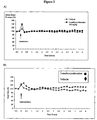
- FIG. 2 shows that 2-methoxyadenosine (0.6 mg/kg p.o.) has no significant effect on blood pressure or heart rate
- FIG. 3 shows the change in plasma concentration over time after administration of 2-methoxyadenosine.
- FIG. 1 A. 2-methoxyadenosine (62.4 and 624 ⁇ g/kg i.p.) inhibits carrageenan (CGN) induced inflammation with comparable efficacy to indomethacin (3 mg/kg, po), without affecting blood pressure. Carrageenan (2%, 10 microlitres) was administered into the right hind paw, and the paw volume assessed by plethysomometry. 2-methoxyadenosine was administered at the same time as carrageenan. 2-methoxyadenosine was as effective as indomethacin (Indo, 3 mg/kg p.o.).
- FIG. 2 An implantable radiotelemetry device was placed in the abdominal cavity of 6 rats per group.
- the pressure catheter of the device was inserted in the abdominal aorta and two electrodes tunnelised under the skin in a lead II position (left side of abdominal cavity/right shoulder).
- Individual rats were placed in their own cage on a radioreceptor (DSI) for data acquisition.
- DSI radioreceptor
- the effect of 0.6 mg/kg 2-methoxyadenosine or vehicle (p.o.) on blood pressure was then assessed.
- A blood pressure
- B heart rate.
- the EC50 value of 2-methoxyadenosine at the adenosine A2A receptor is 900 ng/ml (3 ⁇ M).
- FIG. 3 shows the change in plasma concentration over time after administration of 2-methoxyadenosine at 0.6 mg/kg to a rat. It can be seen that the plasma concentration remains above 2% of the EC50 value for more than 3 hours. Anti-inflammatory effects have been observed (without blood pressure changes) when the peak and maintained plasma concentrations are as low 8 ng/ml (i.e. 2% of the EC50 value determined in vitro). If the peak plasma concentration reaches the 900 ng/ml level (i.e. the EC50 value) profound reductions in blood pressure occur that last for many hours.
Abstract

Description

wherein R is C1-4 alkoxy and X is OH;
for the manufacture of a medicament for the prevention, treatment, or amelioration of cancer, inflammation, auto-immune disease, ischemia-reperfusion injury, epilepsy, sepsis, septic shock, neurodegeneration (including Alzheimer's Disease), muscle fatigue or muscle cramp (particularly athletes' cramp).

wherein R is C1-4 alkoxy, and X is H;
for the manufacture of a medicament for the prevention, treatment, or amelioration of cancer, inflammation, auto-immune disease, ischemia-reperfusion injury, epilepsy, sepsis, septic shock, neurodegeneration (including Alzheimer's Disease), muscle fatigue or muscle cramp (particularly athletes' cramp).
Claims (14)

Priority Applications (1)
| Application Number | Priority Date | Filing Date | Title |
|---|---|---|---|
| US12/875,035 US20110166093A1 (en) | 2003-03-07 | 2010-09-02 | Use of adenosine receptor agonists in therapy |
Applications Claiming Priority (3)
| Application Number | Priority Date | Filing Date | Title |
|---|---|---|---|
| GBGB0305150.5A GB0305150D0 (en) | 2003-03-07 | 2003-03-07 | Use of therapeutic compounds |
| GB0305150.5 | 2003-03-07 | ||
| PCT/GB2004/000952 WO2004078184A1 (en) | 2003-03-07 | 2004-03-05 | Use of adenosine receptor agonists in therapy |
Related Child Applications (1)
| Application Number | Title | Priority Date | Filing Date |
|---|---|---|---|
| US12/875,035 Continuation US20110166093A1 (en) | 2003-03-07 | 2010-09-02 | Use of adenosine receptor agonists in therapy |
Publications (2)
| Publication Number | Publication Date |
|---|---|
| US20060234975A1 US20060234975A1 (en) | 2006-10-19 |
| US7790698B2 true US7790698B2 (en) | 2010-09-07 |
Family
ID=9954248
Family Applications (2)
| Application Number | Title | Priority Date | Filing Date |
|---|---|---|---|
| US10/547,454 Expired - Fee Related US7790698B2 (en) | 2003-03-07 | 2004-03-05 | Use of adenosine receptor agonists in therapy |
| US12/875,035 Abandoned US20110166093A1 (en) | 2003-03-07 | 2010-09-02 | Use of adenosine receptor agonists in therapy |
Family Applications After (1)
| Application Number | Title | Priority Date | Filing Date |
|---|---|---|---|
| US12/875,035 Abandoned US20110166093A1 (en) | 2003-03-07 | 2010-09-02 | Use of adenosine receptor agonists in therapy |
Country Status (11)
| Country | Link |
|---|---|
| US (2) | US7790698B2 (en) |
| EP (1) | EP1603576A1 (en) |
| JP (2) | JP2006519824A (en) |
| KR (1) | KR20050115895A (en) |
| CN (2) | CN102058614A (en) |
| AU (1) | AU2004216891B2 (en) |
| CA (1) | CA2514848A1 (en) |
| GB (1) | GB0305150D0 (en) |
| NO (1) | NO20054475L (en) |
| NZ (1) | NZ541587A (en) |
| WO (1) | WO2004078184A1 (en) |
Cited By (4)
| Publication number | Priority date | Publication date | Assignee | Title |
|---|---|---|---|---|
| US20070010475A1 (en) * | 2002-12-09 | 2007-01-11 | Peter Richardson | Use of spongosine (2-methoxyadenosein) for the treatment of pain, in particular hyperalgesia |
| US20070059773A1 (en) * | 2003-03-07 | 2007-03-15 | Peter Richardson | Identification of therapeutic compounds |
| US20080221060A1 (en) * | 2004-03-05 | 2008-09-11 | Martyn Pritchard | Therapeutic Compounds |
| US20110166093A1 (en) * | 2003-03-07 | 2011-07-07 | Peter Richardson | Use of adenosine receptor agonists in therapy |
Families Citing this family (16)
| Publication number | Priority date | Publication date | Assignee | Title |
|---|---|---|---|---|
| PE20060272A1 (en) | 2004-05-24 | 2006-05-22 | Glaxo Group Ltd | (2R, 3R, 4S, 5R, 2'R, 3'R, 4'S, 5'S) -2.2 '- {TRANS-1,4-CYCLOHEXANODIYLBIS- [IMINO (2 - {[2- (1-METHYL- 1H-IMIDAZOL-4-IL) ETHYL] AMINO} -9H-PURIN-6,9-DIYL)]} BIS [5- (2-ETHYL-2H-TETRAZOLE-5-IL) TETRAHYDRO-3,4-FURANODIOL] AS AN A2A AGONIST |
| AU2005302090A1 (en) * | 2004-11-08 | 2006-05-11 | Can-Fite Biopharma Ltd. | Therapeutic treatment of accelerated bone resorption |
| US20060276393A1 (en) * | 2005-01-13 | 2006-12-07 | Sirtris Pharmaceuticals, Inc. | Novel compositions for preventing and treating neurodegenerative and blood coagulation disorders |
| GB0514809D0 (en) | 2005-07-19 | 2005-08-24 | Glaxo Group Ltd | Compounds |
| US20080300213A1 (en) * | 2005-11-30 | 2008-12-04 | Pnina Fishman | Use of A3 Adenosine Receptor Agonist in Osteoarthritis Treatment |
| NZ573307A (en) | 2006-06-27 | 2012-02-24 | Biovitrum Ab Publ | 2-0'-methyladen0sine derivatives and their use as agonists or antagonists of an adenosine receptor |
| CA2657973A1 (en) | 2006-06-27 | 2008-01-03 | Biovitrum Ab (Publ) | Therapeutic compounds |
| US7807685B2 (en) | 2006-06-27 | 2010-10-05 | Cbt Development Limited | Therapeutic compounds |
| RU2012104552A (en) * | 2009-07-09 | 2013-08-20 | СиБиТи ДЕВЕЛОПМЕНТ ЛИМИТЕД | COMBINED DRUG FOR USE AS A MEDICINAL PRODUCT |
| CN101947230B (en) * | 2010-08-25 | 2012-10-10 | 苗志敏 | Application of 5'-AMP for treating urarthritis |
| CN103342727A (en) * | 2013-07-01 | 2013-10-09 | 淮海工学院 | Synthetic method of 2-methoxyl adenosine |
| CN108329372B (en) * | 2017-01-20 | 2022-07-26 | 浙江省亚热带作物研究所 | N 6 Application of- (2-hydroxyethyl) adenosine and derivatives thereof in preparation of medicines for treating gout |
| JP7025129B2 (en) * | 2017-05-17 | 2022-02-24 | 小林製薬株式会社 | Muscle spasm remedy |
| WO2020176544A1 (en) * | 2019-02-25 | 2020-09-03 | Saint Louis University | Treatment of alzheimer's disease |
| JPWO2022050230A1 (en) * | 2020-09-03 | 2022-03-10 | ||
| CN113116900B (en) * | 2021-04-14 | 2022-07-08 | 兰州大学 | Application of nucleoside analogs in preparation of drugs for preventing and/or treating cerebrovascular diseases |
Citations (17)
| Publication number | Priority date | Publication date | Assignee | Title |
|---|---|---|---|---|
| DE2258378A1 (en) | 1971-12-01 | 1973-06-14 | Takeda Chemical Industries Ltd | ADENOSINE DERIVATIVES, THEIR PRODUCTION AND USE |
| AU4941272A (en) | 1971-12-01 | 1974-05-30 | Takeda Chemical Industries, Ltd | A method for producing 2 substituted adenosine derivatives |
| US3936439A (en) | 1972-12-08 | 1976-02-03 | Takeda Chemical Industries, Ltd. | 2,6-Diaminonebularine derivatives |
| US4225591A (en) | 1977-10-21 | 1980-09-30 | Takeda Chemical Industries, Ltd. | 2,6-Diaminonebularines |
| US4255565A (en) | 1977-10-21 | 1981-03-10 | Takeda Chemical Industries, Ltd. | Production of 2,6-diaminonebularines |
| US4705758A (en) | 1984-06-19 | 1987-11-10 | Warner-Lambert Company | Adenosine receptor assay and kit |
| US5104859A (en) | 1985-09-24 | 1992-04-14 | Solimedco Aktiebolag | Continuous administration of adenosine to reduce pulmonary vascular resistance |
| WO1996038728A1 (en) | 1995-06-02 | 1996-12-05 | Schering-Plough S.P.A. | A METHOD FOR MEASURING THE A2a RECEPTOR BINDING ACTIVITY OF COMPOUNDS OF PHARMACOLOGICAL INTEREST BY THE USE OF THE TRITIATED LIGAND (3H)-SCH 58261 |
| US5677290A (en) * | 1990-05-10 | 1997-10-14 | Fukunaga; Atsuo F. | Therapeutic use of adenosine compounds as surgical anesthetics |
| US5679650A (en) * | 1993-11-24 | 1997-10-21 | Fukunaga; Atsuo F. | Pharmaceutical compositions including mixtures of an adenosine compound and a catecholamine |
| US5683989A (en) * | 1993-12-17 | 1997-11-04 | Novo Nordisk A/S | Treatment of ischemias by administration of 2,N6 -substituted adenosines |
| US5731296A (en) | 1985-09-24 | 1998-03-24 | Item Development Ab | Selective vasodilation by continuous adenosine infusion |
| US5877180A (en) | 1994-07-11 | 1999-03-02 | University Of Virginia Patent Foundation | Method for treating inflammatory diseases with A2a adenosine receptor agonists |
| WO1999034804A1 (en) | 1998-01-08 | 1999-07-15 | The University Of Virginia Patent Foundation | A2a adenosine receptor agonists |
| US6004945A (en) | 1990-05-10 | 1999-12-21 | Fukunaga; Atsuo F. | Use of adenosine compounds to relieve pain |
| US6180616B1 (en) | 1990-05-10 | 2001-01-30 | Atsuo F. Fukunaga | Use of purine receptor agonists to alleviate or normalize physiopathologically excited sensory nerve function |
| WO2004079329A2 (en) | 2003-03-07 | 2004-09-16 | Cambridge Biotechnology Ltd | Identification of therapeutic compounds |
Family Cites Families (3)
| Publication number | Priority date | Publication date | Assignee | Title |
|---|---|---|---|---|
| US20030008841A1 (en) * | 2000-08-30 | 2003-01-09 | Rene Devos | Anti-HCV nucleoside derivatives |
| GB0305149D0 (en) * | 2003-03-07 | 2003-04-09 | Cambridge Biotechnology Ltd | Compounds for the treatment of pain |
| GB0305150D0 (en) * | 2003-03-07 | 2003-04-09 | Cambridge Biotechnology Ltd | Use of therapeutic compounds |
-
2003
- 2003-03-07 GB GBGB0305150.5A patent/GB0305150D0/en not_active Ceased
-
2004
- 2004-03-05 NZ NZ541587A patent/NZ541587A/en unknown
- 2004-03-05 CA CA002514848A patent/CA2514848A1/en not_active Abandoned
- 2004-03-05 CN CN201010524262XA patent/CN102058614A/en active Pending
- 2004-03-05 AU AU2004216891A patent/AU2004216891B2/en not_active Ceased
- 2004-03-05 JP JP2006505924A patent/JP2006519824A/en not_active Ceased
- 2004-03-05 US US10/547,454 patent/US7790698B2/en not_active Expired - Fee Related
- 2004-03-05 WO PCT/GB2004/000952 patent/WO2004078184A1/en active Application Filing
- 2004-03-05 EP EP04717693A patent/EP1603576A1/en not_active Withdrawn
- 2004-03-05 KR KR1020057016713A patent/KR20050115895A/en not_active Application Discontinuation
- 2004-03-05 CN CNA2004800057235A patent/CN1809365A/en active Pending
-
2005
- 2005-09-27 NO NO20054475A patent/NO20054475L/en not_active Application Discontinuation
-
2010
- 2010-09-02 US US12/875,035 patent/US20110166093A1/en not_active Abandoned
-
2012
- 2012-01-06 JP JP2012001451A patent/JP2012111764A/en active Pending
Patent Citations (21)
| Publication number | Priority date | Publication date | Assignee | Title |
|---|---|---|---|---|
| DE2258378A1 (en) | 1971-12-01 | 1973-06-14 | Takeda Chemical Industries Ltd | ADENOSINE DERIVATIVES, THEIR PRODUCTION AND USE |
| FR2162128A1 (en) | 1971-12-01 | 1973-07-13 | Takeda Chemical Industries Ltd | 2-alkoxy-and aryloxyadenosines - hypotensives and coronary vasodilators |
| AU4941272A (en) | 1971-12-01 | 1974-05-30 | Takeda Chemical Industries, Ltd | A method for producing 2 substituted adenosine derivatives |
| US3936439A (en) | 1972-12-08 | 1976-02-03 | Takeda Chemical Industries, Ltd. | 2,6-Diaminonebularine derivatives |
| US4225591A (en) | 1977-10-21 | 1980-09-30 | Takeda Chemical Industries, Ltd. | 2,6-Diaminonebularines |
| US4255565A (en) | 1977-10-21 | 1981-03-10 | Takeda Chemical Industries, Ltd. | Production of 2,6-diaminonebularines |
| US4705758A (en) | 1984-06-19 | 1987-11-10 | Warner-Lambert Company | Adenosine receptor assay and kit |
| US5104859A (en) | 1985-09-24 | 1992-04-14 | Solimedco Aktiebolag | Continuous administration of adenosine to reduce pulmonary vascular resistance |
| US5731296A (en) | 1985-09-24 | 1998-03-24 | Item Development Ab | Selective vasodilation by continuous adenosine infusion |
| US6642209B1 (en) | 1990-05-10 | 2003-11-04 | Atsuo F. Fukunaga | Use of adenosine compounds to alleviate or normalize pathologically hyperexcited sensory nerve function in a human patient |
| US5677290A (en) * | 1990-05-10 | 1997-10-14 | Fukunaga; Atsuo F. | Therapeutic use of adenosine compounds as surgical anesthetics |
| US5942497A (en) * | 1990-05-10 | 1999-08-24 | Fukunaga; Atsuo F. | Purine compound and catecholamine compound containing compositions and methods for administration |
| US5679649A (en) | 1990-05-10 | 1997-10-21 | Fukunaga; Atsuo F. | Use of adenosine compounds for autonomic nervous system attenuation |
| US6180616B1 (en) | 1990-05-10 | 2001-01-30 | Atsuo F. Fukunaga | Use of purine receptor agonists to alleviate or normalize physiopathologically excited sensory nerve function |
| US6004945A (en) | 1990-05-10 | 1999-12-21 | Fukunaga; Atsuo F. | Use of adenosine compounds to relieve pain |
| US5679650A (en) * | 1993-11-24 | 1997-10-21 | Fukunaga; Atsuo F. | Pharmaceutical compositions including mixtures of an adenosine compound and a catecholamine |
| US5683989A (en) * | 1993-12-17 | 1997-11-04 | Novo Nordisk A/S | Treatment of ischemias by administration of 2,N6 -substituted adenosines |
| US5877180A (en) | 1994-07-11 | 1999-03-02 | University Of Virginia Patent Foundation | Method for treating inflammatory diseases with A2a adenosine receptor agonists |
| WO1996038728A1 (en) | 1995-06-02 | 1996-12-05 | Schering-Plough S.P.A. | A METHOD FOR MEASURING THE A2a RECEPTOR BINDING ACTIVITY OF COMPOUNDS OF PHARMACOLOGICAL INTEREST BY THE USE OF THE TRITIATED LIGAND (3H)-SCH 58261 |
| WO1999034804A1 (en) | 1998-01-08 | 1999-07-15 | The University Of Virginia Patent Foundation | A2a adenosine receptor agonists |
| WO2004079329A2 (en) | 2003-03-07 | 2004-09-16 | Cambridge Biotechnology Ltd | Identification of therapeutic compounds |
Non-Patent Citations (62)
Cited By (6)
| Publication number | Priority date | Publication date | Assignee | Title |
|---|---|---|---|---|
| US20070010475A1 (en) * | 2002-12-09 | 2007-01-11 | Peter Richardson | Use of spongosine (2-methoxyadenosein) for the treatment of pain, in particular hyperalgesia |
| US20110184065A1 (en) * | 2002-12-09 | 2011-07-28 | Cambridge Biotechnology Ltd., a United Kingdom corporation | Use of spongosine for the treatment of pain |
| US8252766B2 (en) * | 2002-12-09 | 2012-08-28 | Cbt Development Limited | Use of spongosine for the treatment of pain |
| US20070059773A1 (en) * | 2003-03-07 | 2007-03-15 | Peter Richardson | Identification of therapeutic compounds |
| US20110166093A1 (en) * | 2003-03-07 | 2011-07-07 | Peter Richardson | Use of adenosine receptor agonists in therapy |
| US20080221060A1 (en) * | 2004-03-05 | 2008-09-11 | Martyn Pritchard | Therapeutic Compounds |
Also Published As
| Publication number | Publication date |
|---|---|
| NZ541587A (en) | 2008-08-29 |
| CN1809365A (en) | 2006-07-26 |
| WO2004078184A1 (en) | 2004-09-16 |
| AU2004216891B2 (en) | 2009-06-18 |
| US20110166093A1 (en) | 2011-07-07 |
| JP2012111764A (en) | 2012-06-14 |
| US20060234975A1 (en) | 2006-10-19 |
| CA2514848A1 (en) | 2004-09-16 |
| NO20054475L (en) | 2005-09-27 |
| CN102058614A (en) | 2011-05-18 |
| JP2006519824A (en) | 2006-08-31 |
| EP1603576A1 (en) | 2005-12-14 |
| KR20050115895A (en) | 2005-12-08 |
| AU2004216891A1 (en) | 2004-09-16 |
| GB0305150D0 (en) | 2003-04-09 |
Similar Documents
| Publication | Publication Date | Title |
|---|---|---|
| US20110166093A1 (en) | Use of adenosine receptor agonists in therapy | |
| EP1603577B1 (en) | Compounds for the treatment of pain | |
| US8106029B2 (en) | Use of A2A adenosine receptor agonists | |
| SG194352A1 (en) | Methods, compositions, and formulations for preventing or reducing adverse effects in a patient | |
| EP1272897B1 (en) | Adenosine a2a receptor antagonists for treating and preventing hepatic fibrosis, cirrhosis and fatty liver | |
| US20090253665A1 (en) | Method of treatment of disease using an adenosine a1 receptor antagonist and an aldosterone inhibitor | |
| AU690839B2 (en) | Adenosine as a positive inotrop in the compromised heart | |
| JP4701330B2 (en) | Identification of therapeutic compounds | |
| PT2694074T (en) | Use of a2b adenosine receptor antagonists for treating heart failure and arrhythmia in post-myocardial infarction patients | |
| EA001099B1 (en) | Injecting medical preparation "citoflavin" possessing cito-pretecting effect | |
| WO1995005834A1 (en) | Use of 2-deoxycoformycin (pentostatin) for treating cerebral and cardiovascular disorders | |
| US8871735B2 (en) | Methods and compositions for providing cardiac protection | |
| JP2001515863A (en) | How to increase bone volume |
Legal Events
| Date | Code | Title | Description |
|---|---|---|---|
| AS | Assignment |
Owner name: CAMBRIDGE BIOTECHNOLOGY LTD, UNITED KINGDOM Free format text: ASSIGNMENT OF ASSIGNORS INTEREST;ASSIGNOR:RICHARDSON, PETER;REEL/FRAME:018063/0797 Effective date: 20051205 |
|
| AS | Assignment |
Owner name: CBT DEVELOPMENT LIMITED, UNITED KINGDOM Free format text: ASSIGNMENT OF ASSIGNORS INTEREST;ASSIGNOR:BIOVITRUM AB (PUBL);REEL/FRAME:025504/0040 Effective date: 20101123 |
|
| AS | Assignment |
Owner name: BIOVITRUM AB (PUBL), SWEDEN Free format text: ASSIGNMENT OF ASSIGNORS INTEREST;ASSIGNOR:CAMBRIDGE BIOTECHNOLOGY LIMITED;REEL/FRAME:028033/0220 Effective date: 20091028 |
|
| CC | Certificate of correction | ||
| REMI | Maintenance fee reminder mailed | ||
| LAPS | Lapse for failure to pay maintenance fees | ||
| STCH | Information on status: patent discontinuation |
Free format text: PATENT EXPIRED DUE TO NONPAYMENT OF MAINTENANCE FEES UNDER 37 CFR 1.362 |
|
| FP | Lapsed due to failure to pay maintenance fee |
Effective date: 20140907 |