US6663643B2 - Surgical suturing instrument and method of use - Google Patents
Surgical suturing instrument and method of use Download PDFInfo
- Publication number
- US6663643B2 US6663643B2 US10/039,601 US3960101A US6663643B2 US 6663643 B2 US6663643 B2 US 6663643B2 US 3960101 A US3960101 A US 3960101A US 6663643 B2 US6663643 B2 US 6663643B2
- Authority
- US
- United States
- Prior art keywords
- suture wire
- wire
- island
- channel
- suturing instrument
- Prior art date
- Legal status (The legal status is an assumption and is not a legal conclusion. Google has not performed a legal analysis and makes no representation as to the accuracy of the status listed.)
- Expired - Lifetime
Links
Images




Classifications
-
- A—HUMAN NECESSITIES
- A61—MEDICAL OR VETERINARY SCIENCE; HYGIENE
- A61F—FILTERS IMPLANTABLE INTO BLOOD VESSELS; PROSTHESES; DEVICES PROVIDING PATENCY TO, OR PREVENTING COLLAPSING OF, TUBULAR STRUCTURES OF THE BODY, e.g. STENTS; ORTHOPAEDIC, NURSING OR CONTRACEPTIVE DEVICES; FOMENTATION; TREATMENT OR PROTECTION OF EYES OR EARS; BANDAGES, DRESSINGS OR ABSORBENT PADS; FIRST-AID KITS
- A61F2/00—Filters implantable into blood vessels; Prostheses, i.e. artificial substitutes or replacements for parts of the body; Appliances for connecting them with the body; Devices providing patency to, or preventing collapsing of, tubular structures of the body, e.g. stents
- A61F2/02—Prostheses implantable into the body
- A61F2/08—Muscles; Tendons; Ligaments
-
- A—HUMAN NECESSITIES
- A61—MEDICAL OR VETERINARY SCIENCE; HYGIENE
- A61B—DIAGNOSIS; SURGERY; IDENTIFICATION
- A61B17/00—Surgical instruments, devices or methods, e.g. tourniquets
- A61B17/04—Surgical instruments, devices or methods, e.g. tourniquets for suturing wounds; Holders or packages for needles or suture materials
- A61B17/0469—Suturing instruments for use in minimally invasive surgery, e.g. endoscopic surgery
-
- A—HUMAN NECESSITIES
- A61—MEDICAL OR VETERINARY SCIENCE; HYGIENE
- A61B—DIAGNOSIS; SURGERY; IDENTIFICATION
- A61B17/00—Surgical instruments, devices or methods, e.g. tourniquets
- A61B17/04—Surgical instruments, devices or methods, e.g. tourniquets for suturing wounds; Holders or packages for needles or suture materials
- A61B17/0483—Hand-held instruments for holding sutures
-
- A—HUMAN NECESSITIES
- A61—MEDICAL OR VETERINARY SCIENCE; HYGIENE
- A61B—DIAGNOSIS; SURGERY; IDENTIFICATION
- A61B17/00—Surgical instruments, devices or methods, e.g. tourniquets
- A61B17/064—Surgical staples, i.e. penetrating the tissue
-
- A—HUMAN NECESSITIES
- A61—MEDICAL OR VETERINARY SCIENCE; HYGIENE
- A61B—DIAGNOSIS; SURGERY; IDENTIFICATION
- A61B17/00—Surgical instruments, devices or methods, e.g. tourniquets
- A61B17/064—Surgical staples, i.e. penetrating the tissue
- A61B17/0644—Surgical staples, i.e. penetrating the tissue penetrating the tissue, deformable to closed position
-
- A—HUMAN NECESSITIES
- A61—MEDICAL OR VETERINARY SCIENCE; HYGIENE
- A61B—DIAGNOSIS; SURGERY; IDENTIFICATION
- A61B17/00—Surgical instruments, devices or methods, e.g. tourniquets
- A61B17/068—Surgical staplers, e.g. containing multiple staples or clamps
-
- A—HUMAN NECESSITIES
- A61—MEDICAL OR VETERINARY SCIENCE; HYGIENE
- A61B—DIAGNOSIS; SURGERY; IDENTIFICATION
- A61B17/00—Surgical instruments, devices or methods, e.g. tourniquets
- A61B17/068—Surgical staplers, e.g. containing multiple staples or clamps
- A61B17/0682—Surgical staplers, e.g. containing multiple staples or clamps for applying U-shaped staples or clamps, e.g. without a forming anvil
-
- A—HUMAN NECESSITIES
- A61—MEDICAL OR VETERINARY SCIENCE; HYGIENE
- A61B—DIAGNOSIS; SURGERY; IDENTIFICATION
- A61B17/00—Surgical instruments, devices or methods, e.g. tourniquets
- A61B17/04—Surgical instruments, devices or methods, e.g. tourniquets for suturing wounds; Holders or packages for needles or suture materials
- A61B17/0467—Instruments for cutting sutures
-
- A—HUMAN NECESSITIES
- A61—MEDICAL OR VETERINARY SCIENCE; HYGIENE
- A61B—DIAGNOSIS; SURGERY; IDENTIFICATION
- A61B17/00—Surgical instruments, devices or methods, e.g. tourniquets
- A61B17/04—Surgical instruments, devices or methods, e.g. tourniquets for suturing wounds; Holders or packages for needles or suture materials
- A61B17/0491—Sewing machines for surgery
-
- A—HUMAN NECESSITIES
- A61—MEDICAL OR VETERINARY SCIENCE; HYGIENE
- A61B—DIAGNOSIS; SURGERY; IDENTIFICATION
- A61B17/00—Surgical instruments, devices or methods, e.g. tourniquets
- A61B17/12—Surgical instruments, devices or methods, e.g. tourniquets for ligaturing or otherwise compressing tubular parts of the body, e.g. blood vessels, umbilical cord
- A61B17/12009—Implements for ligaturing other than by clamps or clips, e.g. using a loop with a slip knot
- A61B17/12013—Implements for ligaturing other than by clamps or clips, e.g. using a loop with a slip knot for use in minimally invasive surgery, e.g. endoscopic surgery
-
- A—HUMAN NECESSITIES
- A61—MEDICAL OR VETERINARY SCIENCE; HYGIENE
- A61B—DIAGNOSIS; SURGERY; IDENTIFICATION
- A61B17/00—Surgical instruments, devices or methods, e.g. tourniquets
- A61B17/28—Surgical forceps
- A61B17/29—Forceps for use in minimally invasive surgery
- A61B17/2909—Handles
-
- A—HUMAN NECESSITIES
- A61—MEDICAL OR VETERINARY SCIENCE; HYGIENE
- A61B—DIAGNOSIS; SURGERY; IDENTIFICATION
- A61B17/00—Surgical instruments, devices or methods, e.g. tourniquets
- A61B2017/00004—(bio)absorbable, (bio)resorbable, resorptive
-
- A—HUMAN NECESSITIES
- A61—MEDICAL OR VETERINARY SCIENCE; HYGIENE
- A61B—DIAGNOSIS; SURGERY; IDENTIFICATION
- A61B17/00—Surgical instruments, devices or methods, e.g. tourniquets
- A61B2017/00743—Type of operation; Specification of treatment sites
- A61B2017/00778—Operations on blood vessels
- A61B2017/00783—Valvuloplasty
-
- A—HUMAN NECESSITIES
- A61—MEDICAL OR VETERINARY SCIENCE; HYGIENE
- A61B—DIAGNOSIS; SURGERY; IDENTIFICATION
- A61B17/00—Surgical instruments, devices or methods, e.g. tourniquets
- A61B17/04—Surgical instruments, devices or methods, e.g. tourniquets for suturing wounds; Holders or packages for needles or suture materials
- A61B17/06—Needles ; Sutures; Needle-suture combinations; Holders or packages for needles or suture materials
- A61B17/06166—Sutures
- A61B2017/06171—Sutures helically or spirally coiled
-
- A—HUMAN NECESSITIES
- A61—MEDICAL OR VETERINARY SCIENCE; HYGIENE
- A61B—DIAGNOSIS; SURGERY; IDENTIFICATION
- A61B17/00—Surgical instruments, devices or methods, e.g. tourniquets
- A61B17/064—Surgical staples, i.e. penetrating the tissue
- A61B2017/0646—Surgical staples, i.e. penetrating the tissue for insertion into cartillege, e.g. meniscus
-
- A—HUMAN NECESSITIES
- A61—MEDICAL OR VETERINARY SCIENCE; HYGIENE
- A61B—DIAGNOSIS; SURGERY; IDENTIFICATION
- A61B17/00—Surgical instruments, devices or methods, e.g. tourniquets
- A61B17/064—Surgical staples, i.e. penetrating the tissue
- A61B2017/0649—Coils or spirals
-
- A—HUMAN NECESSITIES
- A61—MEDICAL OR VETERINARY SCIENCE; HYGIENE
- A61F—FILTERS IMPLANTABLE INTO BLOOD VESSELS; PROSTHESES; DEVICES PROVIDING PATENCY TO, OR PREVENTING COLLAPSING OF, TUBULAR STRUCTURES OF THE BODY, e.g. STENTS; ORTHOPAEDIC, NURSING OR CONTRACEPTIVE DEVICES; FOMENTATION; TREATMENT OR PROTECTION OF EYES OR EARS; BANDAGES, DRESSINGS OR ABSORBENT PADS; FIRST-AID KITS
- A61F2/00—Filters implantable into blood vessels; Prostheses, i.e. artificial substitutes or replacements for parts of the body; Appliances for connecting them with the body; Devices providing patency to, or preventing collapsing of, tubular structures of the body, e.g. stents
- A61F2/0063—Implantable repair or support meshes, e.g. hernia meshes
Definitions
- This invention relates to medical instruments and procedures in general, and more particularly to suturing instruments and methods for suturing.
- Suturing instruments are typically used to secure together two or more portions of a subject patient (e.g., tissue such as muscle or skin) or to attach an object to the patient (e.g., to attach a piece of surgical mesh to the abdominal wall of the patient during hernia repair surgery).
- a subject patient e.g., tissue such as muscle or skin
- an object to the patient e.g., to attach a piece of surgical mesh to the abdominal wall of the patient during hernia repair surgery.
- Certain suturing instruments employ a needle that precedes a length of suture material through a subject.
- U.S. Pat. Nos. 3,470,875; 4,027,608; 4,747,358; 5,308,353; 5,674,230; 5,690,653; 5,759,188; and 5,766,186 generally disclose suturing instruments in which a needle, with trailing suture material, is passed through a subject.
- U.S. Pat. Nos. 4,890,615; 4,935,027; 5,417,700; and 5,728,112 generally disclose suturing instruments in which suture material is passed through the end of a hollow needle after that needle has been passed through a subject.
- a needle must be passed through the subject in order to deploy the suture.
- it is generally desirable to alter each portion of the material being sutured e.g., tissue) as little as possible during the suturing process.
- a suturing instrument has been devised which permits the suture material itself to pierce the subject without the use of a needle.
- this device does not permit adequate flexibility with regard to the type of fastening which may be effected.
- U.S. Pat. No. 5,499,990 discloses a suturing instrument having a pair of jaws at its distal end for clamping together two portions of a subject.
- a 0.25 mm stainless steel suturing wire is advanced to the distal end of the suturing instrument, whereupon the distal end of the suturing wire is caused to travel in a spiral direction so as to create stitches joining together the two portions of the subject.
- the beginning and end portions of the suture may be bent toward the tissue in order to inhibit retraction of the suture wire into the tissue upon removal of the suturing instrument.
- the stainless steel wire is sufficiently firm to hold this locking set.
- the radius of the deployed suture spiral may then be decreased by advancing an outer tube over a portion of the distal end of the instrument. Again, the stainless steel wire is sufficiently firm to hold this reducing set.
- U.S. Pat. No. 4,453,661 discloses a surgical instrument having a pair of jaws at its distal end for clamping together two portions of a subject and applying staples thereto.
- the staples are formed from the distal end of a length of wire. More particularly, the distal end of the wire is passed through a subject and thereafter contacts a die that causes the wire to bend, thereby forming the staple. The wire is sufficiently firm to take on the set imposed by the die. The staple portion is then cut away from the remainder of the wire by a knife.
- the present invention comprises a novel device and method for deploying a flexible elongated element through a subject so as to effect suturing.
- the device includes a proximal end and a distal end, and an advancement unit for longitudinally advancing the flexible elongated element toward the distal end of the device such that a distal end of the flexible elongated element may exit from the distal end of the device with sufficient force to pass through the subject.
- the device also includes a curved die at the distal end of the device for imparting a looping configuration to portions of the flexible elongated element exiting the distal end of the device, and a curved guide at the distal end of the device for receiving the looped flexible elongated element as it returns to the distal end of the device.
- a cutting mechanism is provided to permit the looped flexible elongated element to be separated from the remainder of the flexible elongated element. And in a further feature of the invention, the cutting mechanism is adapted to deform both the leading end and the trailing end of the looped flexible elongated element so that each end is forced distally, toward the subject being sutured.
- FIG. 1 is a side view showing a suturing instrument formed in accordance with the present invention
- FIGS. 2-5 are various views showing various details of the suturing instrument's handle assembly
- FIGS. 6-16 are various views showing various details of the suturing instrument's cannula assembly
- FIG. 17 this figure number has not been used in the application.
- FIGS. 18-21 are various views showing various details of the suturing instrument's wire drive assembly
- FIGS. 22-25 are various views showing various details of the suturing instrument's wire supply cartridge
- FIGS. 26-33 show various steps in a suturing operation conducted with the suturing instrument
- FIG. 34 this figure number has not been used in the application.
- FIGS. 35-37 are schematic side views illustrating the interrelationship between the geometry of the cannula assembly's end effector portion and the leading tip of the suture wire.
- Suturing instrument 2 which comprises one preferred embodiment of the present invention.
- Suturing instrument 2 generally comprises a handle assembly 100 , a cannula assembly 200 , a wire drive assembly 300 (FIG. 5) and a wire supply cartridge 400 , as will hereinafter be described in further detail.
- handle assembly 100 comprises a handle 102 and a lever 104
- cannula assembly 200 comprises a shaft 202 , an end effector 204 and a wire cutting mechanism 206 , as will also hereinafter be described in further detail.
- the suturing instrument's end effector 204 is positioned adjacent to the subject which is to be sutured. Then lever 104 is squeezed towards handle 102 , causing wire drive assembly 300 to draw suture wire out of wire supply cartridge 400 and push the suture wire distally through cannula assembly 200 to end effector 204 , where the suture wire exits the instrument with sufficient force to pass through the subject.
- End effector 204 includes a curved die for imparting a looping configuration to the portions of the suture wire exiting the distal end of the instrument, and a curved guide for receiving the looped suture wire as it returns to the distal end of the instrument. The looped suture wire may then be cut off, at end effector 204 , from the remaining suture wire that extends back through the suturing instrument. Such cutting is preferably automatically effected by wire cutting mechanism 206 at the conclusion of the lever's stroke.
- wire supply cartridge 400 may be supplied separately from suturing instrument 2 , with wire supply cartridge 400 being loaded into suturing instrument 2 prior to commencing a suturing operation. As will also be discussed in further detail below, wire supply cartridge 400 may be disposable, such that the cartridge may be discarded after use.
- handle assembly 100 comprises a housing 106 , with the aforementioned handle 102 being fixedly attached to housing 106 and the aforementioned lever 104 being pivotally connected to housing 106 by a pivot pin 108 .
- the inner end of lever 104 includes a slot 110 for receiving a roll pin 112 therein. Roll pin 112 is also secured to a rack 114 .
- Rack 114 is connected to a compression spring 116 at its distal end.
- Rack 114 includes a length of teeth 118 intermediate to its length, followed by a smooth wall 120 adjacent to its proximal end.
- compression spring 116 normally biases rack 114 proximally, so that lever 104 is biased away from handle 102 ; however, lever 104 may be squeezed toward handle 102 so as to overcome the force of spring 116 , whereby to move rack 114 distally.
- a pawl 122 (FIG.
- a removable shroud 126 selectively closes off the proximal end of housing 106 .
- the removable nature of shroud 126 permits a fresh wire supply cartridge 400 to be loaded into the suturing instrument and an exhausted wire supply cartridge to be removed from the instrument, as will hereinafter be discussed in further detail.
- Cannula assembly 200 is shown in greater detail in FIGS. 6-16. As noted above, cannula assembly 200 (FIG. 2) comprises shaft 202 , end effector 204 and wire cutting mechanism 206 .
- shaft 202 comprises a tube 208 having a distal end 210 and a proximal end 212 .
- a mount 214 is secured to tube 208 near its proximal end whereby shaft 202 , and hence the entire cannula assembly 200 , may be removably attached to housing 106 of handle assembly 100 .
- Mount 214 includes a flushing port 216 (FIG. 7 ), communicating with the interior of tube 208 via an opening 218 (FIG. 8 ), for cleaning the interior of cannula assembly 200 .
- a cap 220 selectively closes off flushing port 216 .
- End effector 204 is secured to the distal end of tube 208 .
- End effector 204 is configured so as to form a modified suture loop 204 , sometimes referred to as a suture clip or a “B-form loop” or a “B-form clip”, as will hereinafter be discussed.
- end effector 204 comprises a fixed first portion 222 and a fixed second portion 224 .
- fixed first portion 222 includes a first channel 226 for receiving the distal end of the aforementioned wire supply cartridge 400 , a smaller diameter second channel 228 for supporting suture wire as the suture wire emerges from wire supply cartridge 400 , a third channel 230 for receiving suture wire after the suture wire passes by cutting bar channel 232 and for imparting a selected curvature to the suture wire, whereby to form suture loop, as will hereinafter be discussed in further detail, and a fourth channel 233 for receiving the returning end of suture wire, as will hereinafter be discussed.
- Channels 228 , 230 and 233 are coplanar.
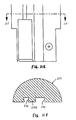
- material is removed from first portion 222 at the locations 234 , 235 and 236 so as to effectively form a pair of islands 237 A and 237 B at the distal end of end effector 204 .
- channels 228 , 230 and 233 may be given an undercut profile such as dovetail (FIGS. 11 A and 11 B), dovetail with flat (FIGS. 11 C and 11 D), T-slot (FIGS. 11 E and 11 F), and/or T-slot with flat (FIGS. 11 E and 11 F).
- channel 235 may be widened slightly at locations other than 240 (FIG. 10 ); locations 240 are, for this particular clip form, contact points for wire bending (other particular clip forms may have other contact points).
- the proximal ends of islands 237 A and 237 B may be relieved slightly at 242 (FIG. 10 ).
- Wire cutting mechanism 206 comprises a cutting bar 246 (FIGS. 2 and 14 - 16 ).
- the distal end of cutting bar 246 is disposed in the aforementioned cutting bar channel 232 and the proximal end of cutting bar 246 protrudes from the proximal end 212 of tube 208 (FIGS. 2 and 8 ).
- the distal end of cutting bar 246 (FIGS. 14-16) preferably comprises a plurality of distinct faces, i.e., a cutting face 248 defining a cutting edge 250 , a relief face 252 set at an angle ⁇ to cutting face 248 , an ejection ramp face 254 , and an ejection push face 258 .
- cutting edge 250 will sever the suture wire
- ejection ramp face 254 will lift the trailing end of the severed suture wire out of cutting bar channel 232 and up over island 236 so that the loop may be released from the distal end of the suturing instrument
- ejection push face 258 will push the suture loop free from the distal end of suturing instrument 2 .
- the proximal end of cutting bar 246 comprises a pusher element 260 (FIGS. 2 and 8) adapted to be engaged by lever 104 when cannula assembly 200 is mounted to handle assembly 100 and lever 104 is pulled toward handle 102 , whereby to move cutting bar 246 distally within cannula assembly 200 .
- a compression spring 262 is located between pusher element 260 and mount 214 so as to bias cutting bar 246 proximally.
- the operations of lever 104 and wire cutting mechanism 206 are preferably coordinated with one another so that pusher element 260 is not engaged by lever 104 until the later part of the lever's stroke, so that advancement of the suture wire will have ceased by the time cutting bar 246 is activated.
- fixed second portion 224 includes a slot 264 which extends proximally from the distal end of the tool. Slot 264 is sized so that when first fixed portion 222 is engaging second fixed portion 224 , a gap slightly wider than the diameter of suture wire will be formed between the tops of islands and the opposing material of fixed second portion 224 , in order to permit a formed loop to be released from the end of the suturing tool, as will also hereinafter be discussed.
- Fixed first portion 222 and fixed second portion 224 are preferably formed out of material which is harder than the suture wire passing through channels 228 , 230 and 233 , so as to minimize wear on the tool.
- FIGS. 11I and 11K illustrate further details regarding alternative end effector 204 .
- wire drive assembly 300 comprises a fixed block 302 , a movable block 304 , a first drive shaft roller 306 connected to a spur gear 308 via an axle 310 passing through fixed block 302 and a one way clutch 312 , and a second drive shaft roller 314 connected to a spur gear 316 via an axle 318 and a one way clutch 320 .
- a pair of capture blocks 322 and 324 rotatably capture drive shaft rollers 306 and 314 to blocks 302 and 304 , respectively.
- Movable block 304 is slidably mounted to fixed block 302 via a pair of rods 326 and 328 that pass through movable block 304 , fixed block 302 and are secured to a cam follower 330 , with springs 332 and 334 biasing movable block 304 into engagement with fixed block 302 .
- a lever 336 and cam 338 are provided for manually forcing movable block 304 away from fixed block 302 , and hence drive shaft roller 314 away from drive shaft roller 306 , and hence spur gear 316 away from spur gear 308 .
- Wire drive assembly 300 is normally disposed in handle assembly 100 so that spur gear 308 and 316 engage the teeth 118 of rack 114 , and so that drive shaft roller 314 is in substantial engagement with drive shaft roller 306 .
- depressing lever 336 will cause cam follower 338 to pivot, whereby to force movable block 304 away from fixed block 302 and whereby to separate roller 314 from roller 306 (and to separate spur gear 316 from spur gear 308 ).
- Wire supply cartridge 400 may then be inserted between rollers 314 and 306 and, by then restoring lever 336 to its inboard position, cause the suture wire to be gripped by rollers 306 and 314 , whereupon the suture wire may be driven by rollers 306 and 314 out the distal end of the suturing instrument.
- suture wire may be driven out the distal end of the instrument by depressing lever 104 toward handle 102 .
- Depressing lever 104 toward handle 102 causes roll pin 112 (FIG. 2) to ride within slot 110 . More particularly, as the top end of lever 104 moves about pivot pin 108 , roll pin 112 moves through slot 110 .
- This causes rack 114 to move distally, which in turn causes spur gears 308 and 316 to rotate, which in turn causes rollers 306 and 314 to rotate, which in turn causes a length of suture wire to be advanced out the distal end of the suturing instrument.
- lever 104 will then cause the cutting bar's pusher element 260 (FIG. 2) to be engaged, whereby cutting bar 246 will sever the formed loop of suture wire from the suture wire remaining in the instrument, lift the trailing end of the suture loop and then push the suture loop free from the suturing instrument.
- lever 104 is released, thereby allowing the aforementioned parts to return to their starting position under the influence of spring 116 .
- clutches 312 and 320 (FIG. 19) interposed between drive rollers 306 and 314 , and the drive rollers 306 and 314 , respectively, prevent reverse movement of the drive rollers, thereby preventing any retraction of the suture wire.
- a single throw of lever 104 will result in a pre-determined degree of movement of drive rollers 306 and 314 , which will in turn result in a pre-determined length of suture wire being advanced out of the distal end of the suturing instrument.
- each drive roller and axle assembly i.e., drive roller 306 and axle 310 , and drive roller 314 and axle 318
- each drive roller and axle assembly is preferably machined (i.e., turned) from a single, continuous piece of metal, using the same tool setup, so that the alignment of both is immune from the inaccuracies which might occur if they were turned at different occasions and assembled using holes and holding means.
- This construction is important, because the drive rollers are approximately 30 times the diameter of the suture wire they are driving and even the slightest alignment inaccuracies can rotate the wire as it is moved forward.
- any such wire rotation may cause the wire to swerve from its normal trajectory from the end effector and possibly prevent the leading tip of the wire from properly returning to the end effector after it has passed through the subject.
- peripheral grooves may be formed in drive rollers 306 and 314 . Such grooves provide a seat for the suture wire being driven and help increase the surface area contact between the drive rollers and the suture wire.
- wire supply cartridge 400 generally comprises a spool housing 402 , a wire spool 404 , a spool retainer spring 406 , a spool cover 408 , a molded tube support 410 and a wire support tube 412 .
- a length of suture wire 416 extends from spool 404 and through molded tube support 410 and wire support tube 412 .
- a supply coil of suture wire 416 (comprising wire formed of metal or any other suitable material having the required flexibility and stiffness) may be supplied in the base of cartridge 400 and is fed into wire support tube 412 .
- Wire support tube 412 surrounds suture wire 416 from spool housing 402 to the distal end of suturing instrument 2 where, with the distal end of wire support tube 412 received in channel 226 , the suture wire enters second channel 228 in end effector 204 .
- Wire support tube 412 ensures that suture wire 416 does not bend or buckle as the suture wire is pushed through handle assembly 100 and cannula assembly 200 .
- wire support tube 412 preferably forms a sufficiently close sliding fit with suture wire 416 such that suture wire 416 cannot bend or buckle as the suture wire is advanced through suturing instrument 2 .
- wire support tube 412 is also formed so as to present a minimum of friction to suture wire 416 as the suture wire is advanced through the instrument. The foregoing characteristics are important, inasmuch as suture wire 416 is extremely thin and flexible and highly susceptible to bending or buckling in the absence of some sort of lateral support.
- wire support tube 412 might have an inside diameter of 0.185 inch and an outside diameter of 0.050 inch.
- wire support tube 412 is preferably formed out of 316 stainless steel, however, it may alternatively be formed out of some other material. If desired, the interior of wire support tube 412 may be coated with a lubricant so as to facilitate closely-supported, low-friction passage of the suture wire through the wire support tube.
- Wire support tube 412 and its surrounding molded tube support 410 have aligned openings 418 and 420 , respectively, on opposite sides thereof. Openings 418 and 420 expose diametrically opposed portions of the suture wire 416 so that rollers 306 and 314 may contact suture wire 416 and urge the suture wire forward toward the distal end of suturing instrument 2 , as will hereinafter be discussed in further detail.
- wire supply cartridge 400 may be loaded into wire drive assembly 300 by actuating lever 336 so as to force movable block 304 away from fixed block 302 and thereby separate rollers 306 and 314 .
- roller 314 is separated from roller 306 by a sufficient distance, wire support tube 412 may be inserted between rollers 306 and 314 , and then roller 314 returned towards roller 306 such that rollers 306 and 314 contact either side of suture wire 416 through the aligned openings 418 and 420 formed in either side of wire support tube 412 and its surrounding molded support tube 410 , respectively.
- Suturing instrument 2 may be used to apply loops 422 of wire suture 416 to a subject so as to effect a desired suturing operation.
- suturing instrument 2 may be used to suture together two portions 500 , 502 of a subject which is to be sutured.
- portions 500 , 502 might comprise two sections of severed tissue which need to be re-attached to one another, or two pieces of previously unattached tissue which need to be attached to one another.
- one or the other of the portions 500 , 502 might also comprise artificial mesh or some other object which is to be attached to tissue, etc.
- portions 500 , 502 might be located relatively deep within a patient, and might be accessed during an endoscopic or a so-called “minimally invasive” or a so-called “closed surgery”, procedure; however, in other circumstances, portions 500 , 502 might be accessed during a conventional, or so-called “open surgery”, procedure. This latter situation might include procedures done at the outer surface of the patient's body, i.e., where portions 500 , 502 comprise surface elements.
- suturing instrument 2 is initially prepared for use by installing a wire supply cartridge 400 into the suturing instrument, if a cartridge 400 is not yet installed.
- wire supply cartridge 400 is installed in suturing instrument 2 by (1) removing shroud 126 , (2) moving the wire drive assembly's release lever 336 to its open position, so as to move rollers 306 and 314 apart; (3) passing the distal end of the cartridge (i.e., the distal end of wire support tube 412 ) through wire drive assembly 300 and cannula assembly 200 until the distal end of wire support tube 412 is located in the end effector's first channel 226 , at which point the cartridge's molded tube support 410 will be positioned intermediate rollers 306 and 314 ; and (4) moving the wire drive assembly's release lever 336 back to its closed position, so that rollers 306 and 314 engage the suture wire 416 through openings 420 and 418 , and so that spur gears 308 and 316 engage the teeth 118 of rack 114
- suturing instrument 2 When suturing instrument 2 is to apply a suture loop 422 to a subject, the distal end of the suturing instrument is positioned against the subject, e.g., it is positioned against portions 500 , 502 (FIG. 10 ).
- End effector 204 is placed against the two pieces of tissue so that channels 230 , 233 contact, or substantially contact, the material to be joined, with channel 230 facing one piece of material (e.g., tissue 500 ) and channel 233 facing the second piece of material (e.g., tissue 502 ).
- end effector 204 may be provided with one or more pins 280 (FIG. 11J) extending distally from its distal end; pins 280 can help stabilize the suturing tool against the tissue.
- pins 280 can hold a prosthesis (e.g., herein mesh) taut against the tissue as the suture wire penetrates it.
- suture wire is advanced out of wire guide 412 , along channel 228 , across cutting bar passageway 232 , along channel 230 , and then out of the tool. Due to the curved geometry of channel 230 , the suture wire emerging from end effector 204 will take on a set, causing it to curl in a loop fashion, whereby the suture wire will pass through the material to be sutured and then back into channel 233 , in the manner shown in FIGS. 28 and 29.
- channel 233 can act as a sort of deflecting anvil to receive and redirect the wire received from channel 235 . In such cases, channel 233 actually helps form loop 422 . However, in accordance with the present invention, it is not necessary for channel 233 to act as a deflecting anvil for wire, since the curvature of loop 233 can be imparted solely by the geometry of channel 230 if desired.
- Suture wire is advanced a predetermined amount, i.e., exactly the right amount to form the desired loop construct.
- suture wire is advanced until the leading end of the suture wire passes across cutting bar passageway 232 and encounters the trailing portion of the suture wire at the point where the suture wire crosses cutting bar passageway 232 , which causes the leading tip 285 (FIGS. 28 and 29) of the suture wire to be deflected distally into the relieved region 234 . At this point the advancement of suture wire is stopped.
- cutting bar 246 is moved distally. This causes the cutting bar to (i) first encounter, and sever, the proximal most portion 290 of the suture wire extending across cutting bar passageway 232 (FIG. 10 ), whereby to separate loop 422 from the remainder of the suture wire carried by the suturing tool, and (ii) then drive against the two ends 285 , 290 of loop 422 whereby, with the assistance of islands 237 A and 237 B, respectively, to bend the ends 285 and 290 toward the material being jointed (FIGS. 31 and 32 ).
- cutting bar 246 includes an ejection ramp at the distal end thereof, and inasmuch as the end effector's fixed second portion 224 includes a slot 264 (FIG. 12) to form a gap in the end of the end effector, distal movement of cutting bar 246 will also serve to lift loop 422 over islands 237 A, 237 B, whereby to disengage the formed loop 422 from the end of suturing tool 422 .
- cutting bar passageway 232 may be offset from the plane of wire channels 228 , 230 and 233 so as to further assist lifting loop 422 over islands 237 A, 237 B.
- islands 237 A and 237 B may be formed so as to be mechanically retractable into the body of fixed first portion 222 , whereby to facilitate disengagement of the formed loop 422 from the tool.
- loop 422 can be used to secure mesh 295 (FIG. 33) to tissue, or to attach other objects to tissue, or to attach objects other than tissue together, etc.
- end effector 204 is provided with one or more distal stabilizing pins 280 (FIG. 12 )
- pins 280 are preferably formed long enough to extend completely through the mesh and contact the underlying tissue.
- wire-related factors e.g., the curvature of third channel 230 , etc.
- wire-related factors e.g., wire tensile strength, wire yield stress, wire diameter, etc.
- tissue-related factors e.g., tissue density, tissue elasticity, tissue thickness, tissue stabilization, etc.
- the aforementioned factors are preferably taken into account when forming wire loops in tissue.
- a relatively “soft” wire when forming a loop in intestine, which tends to be a relatively delicate tissue, it is generally preferable to use a relatively “soft” wire; correspondingly, when forming a loop in the abdominal wall, which tends to be a relatively tough tissue, it is generally preferable to use a relatively “hard” wire.
- suture wire formed out of 316 LVM stainless steel having a tensile strength of 230-260 kpsi and a diameter of about 0.006-0.019 inch, is advantageous in particular applications.
- suture loops with a diameter of about 0.140-0.165 inch, it has been found acceptable to provide third channel 230 with a radius of 0.050-0.075 inch.
- suture loop 422 can, if desired, have a diameter which exceeds the diameter of suturing instrument.
- cannula assembly 200 can be dismounted from handle assembly 100 , a set of different cannula assemblies, each having different loop-forming characteristics, can be provided to the user for appropriate selection at the time of use.
- wire supply cartridge 400 can be dismounted from suturing instrument 2 , a set of different wire supply cartridges, each having different suture wire characteristics (e.g., material, hardness, diameter, etc.) can be provided to the user for appropriate selection at the time of use.
- suture wire characteristics e.g., material, hardness, diameter, etc.
- loop 422 can be used to secure mesh 502 to tissue 500 , or to attach other objects to tissue, or to attach objects other than tissue together, etc.
- end effector 204 is provided with stabilizing projections 272 , 274 (FIG. 12 )
- projections 272 , 274 are preferably formed narrow enough and long enough to extend completely through the mesh and contact the underlying tissue.
- channels 228 and 230 are positioned on opposing sides of cutting bar channel 232 , whereby a length of suture wire 416 , extending between channels 228 and 230 , may be severed by cutting bar 246 .
- the angle at which cutting bar channel 232 intersects channel 228 has a bearing on the angle imparted to the leading tip 424 of suture wire 416 . More particularly, in FIG. 35 it will be seen that cutting bar channel 232 intersects second channel 228 at the angle ⁇ ; as a result, the leading tip of suture wire 416 will also be set at the angle ⁇ .
- the angle ⁇ be as small as possible, in order that the suture wire have the sharpest possible tip to facilitate tissue penetration.
- the leading tip of suture wire 416 must traverse the substantial curvature of third channel 230 and, if the angle ⁇ is too small, the sharp leading tip of the suture wire will strike the wall of third channel 230 (FIG. 36) and thereby become damaged and/or blunted.
- the angle ⁇ is increased, the heel of the tip will engage the wall of third channel 230 (FIG. 37 ), thereby leaving the sharp tip of the suture wire undamaged.
- the angle ⁇ be set so that the leading tip of suture wire 416 be formed as sharp as possible while still being able to traverse the curvature of third channel 230 without damage.
- suture loop 422 can be used to secure tissue to tissue, or to secure an inanimate object to tissue, or to secure an inanimate object to an inanimate object, etc.
- one anticipated application for suture loop 422 is to secure a prosthetic cardiac valve to a valve seat within the heart.
- suture wire 416 is described as comprising an elongated length which is cut into specific lengths at the time of use by the action of cutting bar 246 .
- suture wire 416 may be pre-cut into selected lengths prior to use, and the pre-cut lengths then stored in a magazine or the like, for deployment at the time of use.
- cutting bar 246 will act as a forming and ejecting tool rather than as a cutting, forming and ejecting tool.
- suture wire 416 may comprise a wire formed out of a metal or any other suitable material having the required flexibility and stiffness.
- suture wire 416 may comprise stainless steel, titanium, tantalum, etc.
- suture wire 416 may also be coated with various active agents.
- suture wire 416 may be coated with an anti-inflammatory agent, or an anti-coagulant agent, or an antibiotic, or a radioactive agent, etc.
- shaft 202 has been shown as being substantially straight; however, it is also anticipated that shaft 202 may be curved along its length. Furthermore, shaft 202 may be substantially rigid, or it may be flexible so that it can be bent along its length. It is also possible to form shaft 202 so that it has two or more articulating sections so as to aid in the positioning of end effector 204 .
Abstract
Description
Claims (37)
Priority Applications (2)
| Application Number | Priority Date | Filing Date | Title |
|---|---|---|---|
| US10/039,601 US6663643B2 (en) | 2000-03-27 | 2001-10-19 | Surgical suturing instrument and method of use |
| US10/737,197 US20050070922A1 (en) | 2000-03-27 | 2003-12-16 | Surgical suturing instrument and method of use |
Applications Claiming Priority (5)
| Application Number | Priority Date | Filing Date | Title |
|---|---|---|---|
| US19248700P | 2000-03-27 | 2000-03-27 | |
| US24216600P | 2000-10-20 | 2000-10-20 | |
| US24193600P | 2000-10-20 | 2000-10-20 | |
| US09/818,300 US6527785B2 (en) | 1999-08-03 | 2001-03-27 | Surgical suturing instrument and method of use |
| US10/039,601 US6663643B2 (en) | 2000-03-27 | 2001-10-19 | Surgical suturing instrument and method of use |
Related Parent Applications (1)
| Application Number | Title | Priority Date | Filing Date |
|---|---|---|---|
| US09/818,300 Continuation-In-Part US6527785B2 (en) | 1999-08-03 | 2001-03-27 | Surgical suturing instrument and method of use |
Related Child Applications (1)
| Application Number | Title | Priority Date | Filing Date |
|---|---|---|---|
| US10/737,197 Continuation US20050070922A1 (en) | 2000-03-27 | 2003-12-16 | Surgical suturing instrument and method of use |
Publications (2)
| Publication Number | Publication Date |
|---|---|
| US20030050650A1 US20030050650A1 (en) | 2003-03-13 |
| US6663643B2 true US6663643B2 (en) | 2003-12-16 |
Family
ID=34382227
Family Applications (2)
| Application Number | Title | Priority Date | Filing Date |
|---|---|---|---|
| US10/039,601 Expired - Lifetime US6663643B2 (en) | 2000-03-27 | 2001-10-19 | Surgical suturing instrument and method of use |
| US10/737,197 Abandoned US20050070922A1 (en) | 2000-03-27 | 2003-12-16 | Surgical suturing instrument and method of use |
Family Applications After (1)
| Application Number | Title | Priority Date | Filing Date |
|---|---|---|---|
| US10/737,197 Abandoned US20050070922A1 (en) | 2000-03-27 | 2003-12-16 | Surgical suturing instrument and method of use |
Country Status (1)
| Country | Link |
|---|---|
| US (2) | US6663643B2 (en) |
Cited By (31)
| Publication number | Priority date | Publication date | Assignee | Title |
|---|---|---|---|---|
| US20020143354A1 (en) * | 1999-09-21 | 2002-10-03 | Dieter Lang | Medical instrument |
| US20050070922A1 (en) * | 2000-03-27 | 2005-03-31 | Field Frederic P. | Surgical suturing instrument and method of use |
| US20080283576A1 (en) * | 2007-05-16 | 2008-11-20 | Searete Llc. A Limited Liability Corporation Of The State Of Delaware | Surgical fastening device with cutter |
| US7601161B1 (en) | 1999-07-02 | 2009-10-13 | Quick Pass, Inc. | Suturing device |
| US7666194B2 (en) | 2000-10-20 | 2010-02-23 | Onux Medical, Inc. | Surgical suturing instrument and method of use |
| US7798385B2 (en) | 2007-05-16 | 2010-09-21 | The Invention Science Fund I, Llc | Surgical stapling instrument with chemical sealant |
| US7810691B2 (en) | 2007-05-16 | 2010-10-12 | The Invention Science Fund I, Llc | Gentle touch surgical stapler |
| US7823761B2 (en) | 2007-05-16 | 2010-11-02 | The Invention Science Fund I, Llc | Maneuverable surgical stapler |
| US7832611B2 (en) | 2007-05-16 | 2010-11-16 | The Invention Science Fund I, Llc | Steerable surgical stapler |
| US8105355B2 (en) | 2006-05-18 | 2012-01-31 | C.R. Bard, Inc. | Suture lock fastening device |
| US8177796B2 (en) | 2009-03-23 | 2012-05-15 | Linvatec Corporation | Suture passing apparatus and method |
| US8287556B2 (en) | 2008-06-17 | 2012-10-16 | Apollo Endosurgery, Inc. | Endoscopic suturing system |
| US8485411B2 (en) | 2007-05-16 | 2013-07-16 | The Invention Science Fund I, Llc | Gentle touch surgical stapler |
| US20130184720A1 (en) * | 2012-01-13 | 2013-07-18 | Dallen Medical, Inc. | Actuator for band tensioning system |
| US8679136B2 (en) | 2008-06-17 | 2014-03-25 | Apollo Endosurgery, Inc. | Needle capture device |
| US9131938B2 (en) | 2007-03-29 | 2015-09-15 | Nobles Medical Technologies, Inc. | Suturing devices and methods for closing a patent foramen ovale |
| US9326764B2 (en) | 2008-05-09 | 2016-05-03 | Nobles Medical Technologies Inc. | Suturing devices and methods for suturing an anatomic valve |
| US9486126B2 (en) | 2008-06-17 | 2016-11-08 | Apollo Endosurgery, Inc. | Endoscopic helix tissue grasping device |
| US9642616B2 (en) | 2005-06-20 | 2017-05-09 | Nobles Medical Technologies, Inc. | Method and apparatus for applying a knot to a suture |
| US9649106B2 (en) | 2011-04-15 | 2017-05-16 | Heartstitch, Inc. | Suturing devices and methods for suturing an anatomic valve |
| US9706988B2 (en) | 2012-05-11 | 2017-07-18 | Heartstitch, Inc. | Suturing devices and methods for suturing an anatomic structure |
| US10512458B2 (en) | 2013-12-06 | 2019-12-24 | Med-Venture Investments, Llc | Suturing methods and apparatuses |
| US10687801B2 (en) | 2016-04-11 | 2020-06-23 | Nobles Medical Technologies Ii, Inc. | Suture spools for tissue suturing device |
| US10828022B2 (en) | 2013-07-02 | 2020-11-10 | Med-Venture Investments, Llc | Suturing devices and methods for suturing an anatomic structure |
| US11051800B2 (en) | 2016-08-10 | 2021-07-06 | Apollo Endosurgery Us, Inc. | Endoscopic suturing system having external instrument channel |
| US11141147B2 (en) | 2016-08-10 | 2021-10-12 | Apollo Endosurgery Us, Inc. | Endoscopic suturing system having external instrument channel |
| US11202624B2 (en) | 2017-08-18 | 2021-12-21 | Nobles Medical Technologies Ii, Inc. | Apparatus for applying a knot to a suture |
| US11395658B2 (en) | 2014-07-11 | 2022-07-26 | Cardio Medical Solutions, Inc. | Device and method for assisting end-to-side anastomosis |
| US11812951B2 (en) | 2008-06-17 | 2023-11-14 | Apollo Endosurgery Us, Inc. | Endoscopic needle assembly |
| US11839370B2 (en) | 2017-06-19 | 2023-12-12 | Heartstitch, Inc. | Suturing devices and methods for suturing an opening in the apex of the heart |
| US11957331B2 (en) | 2017-06-19 | 2024-04-16 | Heartstitch, Inc. | Suturing systems and methods for suturing body tissue |
Families Citing this family (20)
| Publication number | Priority date | Publication date | Assignee | Title |
|---|---|---|---|---|
| US5766183A (en) | 1996-10-21 | 1998-06-16 | Lasersurge, Inc. | Vascular hole closure |
| US6332889B1 (en) * | 1998-08-27 | 2001-12-25 | Onux Medical, Inc. | Surgical suturing instrument and method of use |
| US6527785B2 (en) * | 1999-08-03 | 2003-03-04 | Onux Medical, Inc. | Surgical suturing instrument and method of use |
| US6679895B1 (en) * | 1999-11-05 | 2004-01-20 | Onux Medical, Inc. | Apparatus and method for placing suture wires into tissue for the approximation and tensioning of tissue |
| US7011668B2 (en) * | 2001-07-23 | 2006-03-14 | Dvl Acquistion Sub, Inc. | Surgical suturing instrument and method of use |
| AU2002326917A1 (en) * | 2001-09-14 | 2003-04-01 | Onux Medical, Inc. | Surgical suturing instrument and method of use |
| US20030078601A1 (en) * | 2001-10-22 | 2003-04-24 | Oleg Shikhman | Crimping and cutting device |
| ATE502583T1 (en) * | 2001-10-22 | 2011-04-15 | Interventional Therapies Llc | WOUND SEWING DEVICE |
| EP1487352A4 (en) * | 2002-03-25 | 2006-07-12 | Dvl Acquisition Sub Inc | Surgical suturing instrument and method of use |
| CA2484870A1 (en) * | 2002-05-17 | 2003-11-27 | Dvl Acquisition Sub, Inc. | Surgical suturing instrument and method of use |
| AU2003241521A1 (en) * | 2002-05-17 | 2003-12-02 | Onux Medical, Inc. | Surgical suturing instrument and method of use |
| US7981124B2 (en) * | 2007-04-04 | 2011-07-19 | Misder, Llc | Medical device for applying purse string sutures |
| EP2134267A4 (en) * | 2007-04-06 | 2015-02-25 | Interventional Therapies | Suturing, crimping and cutting device |
| FR2924917B1 (en) * | 2007-12-13 | 2011-02-11 | Microval | APPARATUS FOR INSTALLING SUTURE SPIERS RESULTING FROM A SHAPE MEMORY METAL WIRE. |
| US8894669B2 (en) | 2009-05-12 | 2014-11-25 | Ethicon, Inc. | Surgical fasteners, applicator instruments, and methods for deploying surgical fasteners |
| WO2010148388A2 (en) * | 2009-06-19 | 2010-12-23 | Interventional Therapies | Crimping and cutting device |
| GB2514505B (en) | 2012-02-07 | 2016-07-06 | Arthrocare Corp | Surgical instrument for manipulating and passing suture |
| US10004499B2 (en) * | 2015-05-19 | 2018-06-26 | Ethicon, Llc | Applicator instruments having end caps with gripping features |
| US11583274B2 (en) * | 2017-12-21 | 2023-02-21 | Cilag Gmbh International | Self-guiding stapling instrument |
| KR102527300B1 (en) * | 2021-06-10 | 2023-04-27 | 신종수 | Ligation apparatus |
Citations (97)
| Publication number | Priority date | Publication date | Assignee | Title |
|---|---|---|---|---|
| US2613562A (en) | 1947-05-27 | 1952-10-14 | John W Clark | Watch hand pressing tool |
| US2897820A (en) | 1956-10-23 | 1959-08-04 | Tauber Robert | Surgical needle guiding instrument |
| US3404677A (en) | 1965-07-08 | 1968-10-08 | Henry A. Springer | Biopsy and tissue removing device |
| US3470875A (en) | 1966-10-06 | 1969-10-07 | Alfred A Johnson | Surgical clamping and suturing instrument |
| US3545444A (en) | 1967-10-02 | 1970-12-08 | United States Surgical Corp | Wire suture wrapping instrument |
| US3584628A (en) | 1968-10-11 | 1971-06-15 | United States Surgical Corp | Wire suture wrapping instrument |
| US3802438A (en) | 1972-03-31 | 1974-04-09 | Technibiotics | Surgical instrument |
| US3807407A (en) | 1971-06-07 | 1974-04-30 | E Schweizer | Suture applicator |
| US3841521A (en) | 1970-08-17 | 1974-10-15 | R Jarvik | Repeating ligature guns, multi-ligature cartridges and preformed ligatures therefor |
| US3858783A (en) | 1972-11-20 | 1975-01-07 | Nikolai Nikolaevich Kapitanov | Surgical instrument for stitching up tissues with lengths of suture wire |
| US3877570A (en) | 1973-07-25 | 1975-04-15 | Robert J Barry | Sterile cosmetic suture for attaching hair pieces to scalp and method of packaging and utilizing |
| US3959960A (en) | 1975-03-12 | 1976-06-01 | Santos Manuel V | Tensioning, twisting and cutting device for sutures |
| US4006747A (en) | 1975-04-23 | 1977-02-08 | Ethicon, Inc. | Surgical method |
| US4027608A (en) | 1976-02-20 | 1977-06-07 | Raymond Kelder | Suturing device |
| US4103690A (en) | 1977-03-21 | 1978-08-01 | Cordis Corporation | Self-suturing cardiac pacer lead |
| US4109658A (en) | 1977-02-04 | 1978-08-29 | Hughes Joe L | Needle holding device with pick-up means |
| US4204541A (en) | 1977-01-24 | 1980-05-27 | Kapitanov Nikolai N | Surgical instrument for stitching up soft tissues with lengths of spiked suture material |
| US4235177A (en) | 1979-02-23 | 1980-11-25 | Raymond C. Kelder | Suturing device |
| US4258716A (en) | 1978-02-06 | 1981-03-31 | The University Of Melbourne | Microsurgical instruments |
| US4306560A (en) | 1978-07-10 | 1981-12-22 | Cordis Corporation | Suture forming tool for securing an electrode to generally inaccessible body tissue |
| US4453661A (en) | 1980-10-23 | 1984-06-12 | Ivano-Frankovsky Gosudarstvenny Meditsinsky Institut | Surgical instrument for applying staples |
| US4462404A (en) | 1981-01-31 | 1984-07-31 | Vormals Jetter & Scheerer Aesculap-Werke Aktiengesellschaft | Forceps- or tweezers-shaped surgical instrument |
| US4474181A (en) | 1982-02-18 | 1984-10-02 | Schenck Robert R | Method and apparatus for anastomosing small blood vessels |
| US4553543A (en) | 1984-03-05 | 1985-11-19 | Amarasinghe Disamodha C | Suturing assembly and method |
| US4557265A (en) | 1983-02-08 | 1985-12-10 | Innova Ab | Suturing instrument |
| US4583541A (en) | 1984-05-07 | 1986-04-22 | Barry Joseph P | Sternal stabilization device |
| US4602636A (en) | 1983-03-08 | 1986-07-29 | Joint Medical Products Corporation | Suture wire with integral needle-like tip |
| US4607637A (en) | 1983-07-22 | 1986-08-26 | Anders Berggren | Surgical instrument for performing anastomosis with the aid of ring-like fastening elements and the fastening elements for performing anastomosis |
| US4624257A (en) | 1982-06-24 | 1986-11-25 | Anders Berggren | Surgical instrument for performing anastomosis |
| US4643190A (en) | 1984-06-23 | 1987-02-17 | Richard Wolf Gmbh | Medical forceps |
| US4644651A (en) | 1984-03-19 | 1987-02-24 | Jacobsen Research Corp. | Instrument for gripping or cutting |
| US4747358A (en) | 1986-01-30 | 1988-05-31 | G.M.Pfaff Aktiengesellschaft | Surgical suturing machine |
| US4760848A (en) | 1986-11-03 | 1988-08-02 | Hasson Harrith M | Rotational surgical instrument |
| US4763669A (en) | 1986-01-09 | 1988-08-16 | Jaeger John C | Surgical instrument with adjustable angle of operation |
| US4803984A (en) | 1987-07-06 | 1989-02-14 | Montefiore Hospital Association Of Western Pennsylvania | Method for performing small vessel anastomosis |
| US4819635A (en) | 1987-09-18 | 1989-04-11 | Henry Shapiro | Tubular microsurgery cutting apparatus |
| US4890615A (en) | 1987-11-05 | 1990-01-02 | Concept, Inc. | Arthroscopic suturing instrument |
| US4901721A (en) | 1988-08-02 | 1990-02-20 | Hakki Samir I | Suturing device |
| US4915107A (en) | 1988-03-09 | 1990-04-10 | Harley International Medical Ltd. | Automatic instrument for purse-string sutures for surgical use |
| US4935027A (en) * | 1989-08-21 | 1990-06-19 | Inbae Yoon | Surgical suture instrument with remotely controllable suture material advancement |
| US4938214A (en) * | 1984-09-10 | 1990-07-03 | Micrins Surgical Instruments, Ltd. | Hand held surgical tool |
| US4941466A (en) | 1987-04-13 | 1990-07-17 | Romano Jack W | Curved bore drilling method and apparatus |
| US4955887A (en) | 1988-05-11 | 1990-09-11 | Storz Instrument Company | Optical surgical instrument |
| US4957498A (en) * | 1987-11-05 | 1990-09-18 | Concept, Inc. | Suturing instrument |
| US4966600A (en) * | 1989-01-26 | 1990-10-30 | Songer Robert J | Surgical securance method |
| US5002564A (en) | 1989-06-19 | 1991-03-26 | Ethicon, Inc. | Surgical needle configuration with spatula geometry |
| US5004469A (en) * | 1989-03-07 | 1991-04-02 | Ricerche Biomediche S.R.L. | Improvements in automatic mechanical suturing guns |
| US5037433A (en) * | 1990-05-17 | 1991-08-06 | Wilk Peter J | Endoscopic suturing device and related method and suture |
| US5133735A (en) * | 1990-05-10 | 1992-07-28 | Symbiosis Corporation | Thumb-activated actuating member for imparting reciprocal motion to push rod of a disposable laparoscopic surgical instrument |
| US5147373A (en) * | 1991-04-29 | 1992-09-15 | Ferzli George S | Laparoscopic instrument |
| US5171256A (en) | 1990-05-10 | 1992-12-15 | Symbiosis Corporation | Single acting disposable laparoscopic scissors |
| US5174300A (en) | 1991-04-04 | 1992-12-29 | Symbiosis Corporation | Endoscopic surgical instruments having rotatable end effectors |
| US5192298A (en) * | 1990-05-10 | 1993-03-09 | Symbiosis Corporation | Disposable laparoscopic surgical instruments |
| US5217465A (en) * | 1992-02-28 | 1993-06-08 | Alcon Surgical, Inc. | Flexible and steerable aspiration tip for microsurgery |
| US5219357A (en) * | 1990-05-31 | 1993-06-15 | Tnco, Inc. | Micro-instrument |
| US5234453A (en) | 1990-05-10 | 1993-08-10 | Symblosis Corporation | Cobalt base alloy end effectors for laparoscopic surgical scissors |
| US5242459A (en) | 1992-07-10 | 1993-09-07 | Laparomed Corporation | Device and method for applying a ligating loop |
| US5261917A (en) | 1992-02-19 | 1993-11-16 | Hasson Harrith M | Suture tying forceps with a plurality of suture holders and method of tying a suture |
| US5290284A (en) | 1992-05-01 | 1994-03-01 | Adair Edwin Lloyd | Laparoscopic surgical ligation and electrosurgical coagulation and cutting device |
| US5304183A (en) | 1992-03-23 | 1994-04-19 | Laparomed Corporation | Tethered clamp retractor |
| US5306281A (en) | 1992-08-31 | 1994-04-26 | Merrimac Industries, Inc. | Suturing cassette device |
| US5308357A (en) | 1992-08-21 | 1994-05-03 | Microsurge, Inc. | Handle mechanism for manual instruments |
| US5308353A (en) | 1992-08-31 | 1994-05-03 | Merrimac Industries, Inc. | Surgical suturing device |
| US5324308A (en) | 1993-10-28 | 1994-06-28 | Javin Pierce | Suture anchor |
| US5333625A (en) | 1988-08-18 | 1994-08-02 | Rikki Brezak | Suturing with corrosion and breakage resistant flexible wire |
| US5356424A (en) | 1993-02-05 | 1994-10-18 | American Cyanamid Co. | Laparoscopic suturing device |
| US5370658A (en) | 1992-11-05 | 1994-12-06 | Synergetics, Inc. | Microsurgical instrument having dexterous handle with interchangeable instrument heads |
| US5372604A (en) | 1993-06-18 | 1994-12-13 | Linvatec Corporation | Suture anchor for soft tissue fixation |
| US5386741A (en) | 1993-06-07 | 1995-02-07 | Rennex; Brian G. | Robotic snake |
| US5411522A (en) | 1993-08-25 | 1995-05-02 | Linvatec Corporation | Unitary anchor for soft tissue fixation |
| US5417700A (en) | 1992-03-30 | 1995-05-23 | Thomas D. Egan | Automatic suturing and ligating device |
| US5417701A (en) | 1993-03-30 | 1995-05-23 | Holmed Corporation | Surgical instrument with magnetic needle holder |
| US5423821A (en) | 1994-01-18 | 1995-06-13 | Pasque; Michael K. | Sternal closure device |
| US5431670A (en) | 1993-10-13 | 1995-07-11 | Hol-Med Corporation | Surgical suturing instrument |
| US5437681A (en) | 1994-01-13 | 1995-08-01 | Suturtek Inc. | Suturing instrument with thread management |
| US5474554A (en) | 1994-07-27 | 1995-12-12 | Ku; Ming-Chou | Method for fixation of avulsion fracture |
| US5478093A (en) | 1993-06-28 | 1995-12-26 | Dentalwerk Burmoos Gesellschaft M.B.H. | Surgical handpiece |
| US5496334A (en) | 1993-03-31 | 1996-03-05 | J. Stro/ bel & Sohne GmbH & Co. | Suturing apparatus |
| US5498256A (en) | 1993-05-28 | 1996-03-12 | Snowden-Pencer, Inc. | Surgical instrument handle |
| US5499990A (en) | 1992-05-23 | 1996-03-19 | Forschungszentrum Karlsruhe Gmbh | Suturing instrument |
| US5501698A (en) | 1994-02-14 | 1996-03-26 | Heartport, Inc. | Endoscopic microsurgical instruments and methods |
| US5501692A (en) | 1994-01-28 | 1996-03-26 | Riza; Erol D. | Laparoscopic suture snare |
| US5501688A (en) | 1994-02-17 | 1996-03-26 | Surgical Accessories, Inc. | Surgical device for manipulating wire |
| US5571119A (en) | 1993-10-25 | 1996-11-05 | Children's Medical Center Corporation | Retractable suture needle with self-contained driver |
| US5674230A (en) | 1993-10-08 | 1997-10-07 | United States Surgical Corporation | Surgical suturing apparatus with locking mechanisms |
| US5690653A (en) | 1991-09-30 | 1997-11-25 | Richardson; Philip | Suturing apparatus |
| US5709693A (en) | 1996-02-20 | 1998-01-20 | Cardiothoracic System, Inc. | Stitcher |
| US5720766A (en) | 1994-02-23 | 1998-02-24 | Orthopaedic Biosystems Limited, Inc. | Apparatus for attaching soft tissue to bone |
| US5728112A (en) | 1995-09-22 | 1998-03-17 | Yoon; Inbae | Combined tissue clamping and suturing instrument |
| US5759188A (en) | 1996-11-27 | 1998-06-02 | Yoon; Inbae | Suturing instrument with rotatably mounted needle driver and catcher |
| US5766217A (en) | 1996-09-23 | 1998-06-16 | Christy; William J. | Surgical loop delivery device and method |
| US5766186A (en) | 1996-12-03 | 1998-06-16 | Simon Fraser University | Suturing device |
| US5776150A (en) | 1996-06-10 | 1998-07-07 | Ethicon Endo Surgery, Inc. | Suture assist device |
| US5799672A (en) | 1996-07-26 | 1998-09-01 | Hansbury; Barbara J. | Hair retaining device |
| US5814054A (en) | 1996-09-23 | 1998-09-29 | Symbiosis Corporation | Automatic needle-passer suturing instrument |
| US5830234A (en) | 1997-04-04 | 1998-11-03 | Alto Development Corporation | Method for double wire sternotomy suture |
| US6048351A (en) * | 1992-09-04 | 2000-04-11 | Scimed Life Systems, Inc. | Transvaginal suturing system |
Family Cites Families (18)
| Publication number | Priority date | Publication date | Assignee | Title |
|---|---|---|---|---|
| US919138A (en) * | 1909-03-16 | 1909-04-20 | Clarence A Drake | Surgical needle. |
| US1449087A (en) * | 1921-12-05 | 1923-03-20 | Edwin P Bugbee | Suturing instrument |
| US2579192A (en) * | 1950-08-15 | 1951-12-18 | George H Sciaroni | Suturing instrument |
| US3013559A (en) * | 1959-05-06 | 1961-12-19 | Wesley C Thomas | Instrument for closing flesh wounds |
| US3735762A (en) * | 1970-04-27 | 1973-05-29 | Us Corp Baltimo E | Instrument for ligating suturing and dividing organic tubular structures |
| US3840017A (en) * | 1971-10-29 | 1974-10-08 | A Violante | Surgical instrument |
| US4595007A (en) * | 1983-03-14 | 1986-06-17 | Ethicon, Inc. | Split ring type tissue fastener |
| US4610383A (en) * | 1983-10-14 | 1986-09-09 | Senmed, Inc. | Disposable linear surgical stapler |
| US4612933A (en) * | 1984-03-30 | 1986-09-23 | Senmed, Inc. | Multiple-load cartridge assembly for a linear surgical stapling instrument |
| US5161725A (en) * | 1990-02-13 | 1992-11-10 | Ethicon, Inc. | Rotating head skin stapler |
| US5021059A (en) * | 1990-05-07 | 1991-06-04 | Kensey Nash Corporation | Plug device with pulley for sealing punctures in tissue and methods of use |
| US5211650A (en) * | 1991-01-07 | 1993-05-18 | Laparomed Corporation | Dual function suturing device and method |
| US5254126A (en) * | 1992-06-24 | 1993-10-19 | Ethicon, Inc. | Endoscopic suture punch |
| US5522820A (en) * | 1993-01-15 | 1996-06-04 | Arthrotech | Method and apparatus for suturing tissue |
| US6090063A (en) * | 1995-12-01 | 2000-07-18 | C. R. Bard, Inc. | Device, system and method for implantation of filaments and particles in the body |
| US6162233A (en) * | 1996-02-23 | 2000-12-19 | Cardiovascular Technologies, Llc | Wire fasteners for use in minimally invasive surgery and means and methods for handling those fasteners |
| US6663643B2 (en) * | 2000-03-27 | 2003-12-16 | Onux Medical, Inc. | Surgical suturing instrument and method of use |
| EP1487352A4 (en) * | 2002-03-25 | 2006-07-12 | Dvl Acquisition Sub Inc | Surgical suturing instrument and method of use |
-
2001
- 2001-10-19 US US10/039,601 patent/US6663643B2/en not_active Expired - Lifetime
-
2003
- 2003-12-16 US US10/737,197 patent/US20050070922A1/en not_active Abandoned
Patent Citations (104)
| Publication number | Priority date | Publication date | Assignee | Title |
|---|---|---|---|---|
| US2613562A (en) | 1947-05-27 | 1952-10-14 | John W Clark | Watch hand pressing tool |
| US2897820A (en) | 1956-10-23 | 1959-08-04 | Tauber Robert | Surgical needle guiding instrument |
| US3404677A (en) | 1965-07-08 | 1968-10-08 | Henry A. Springer | Biopsy and tissue removing device |
| US3470875A (en) | 1966-10-06 | 1969-10-07 | Alfred A Johnson | Surgical clamping and suturing instrument |
| US3545444A (en) | 1967-10-02 | 1970-12-08 | United States Surgical Corp | Wire suture wrapping instrument |
| US3584628A (en) | 1968-10-11 | 1971-06-15 | United States Surgical Corp | Wire suture wrapping instrument |
| US3841521A (en) | 1970-08-17 | 1974-10-15 | R Jarvik | Repeating ligature guns, multi-ligature cartridges and preformed ligatures therefor |
| US3807407A (en) | 1971-06-07 | 1974-04-30 | E Schweizer | Suture applicator |
| US3802438A (en) | 1972-03-31 | 1974-04-09 | Technibiotics | Surgical instrument |
| US3858783A (en) | 1972-11-20 | 1975-01-07 | Nikolai Nikolaevich Kapitanov | Surgical instrument for stitching up tissues with lengths of suture wire |
| US3877570A (en) | 1973-07-25 | 1975-04-15 | Robert J Barry | Sterile cosmetic suture for attaching hair pieces to scalp and method of packaging and utilizing |
| US3959960A (en) | 1975-03-12 | 1976-06-01 | Santos Manuel V | Tensioning, twisting and cutting device for sutures |
| US4006747A (en) | 1975-04-23 | 1977-02-08 | Ethicon, Inc. | Surgical method |
| US4027608A (en) | 1976-02-20 | 1977-06-07 | Raymond Kelder | Suturing device |
| US4204541A (en) | 1977-01-24 | 1980-05-27 | Kapitanov Nikolai N | Surgical instrument for stitching up soft tissues with lengths of spiked suture material |
| US4109658A (en) | 1977-02-04 | 1978-08-29 | Hughes Joe L | Needle holding device with pick-up means |
| US4103690A (en) | 1977-03-21 | 1978-08-01 | Cordis Corporation | Self-suturing cardiac pacer lead |
| US4258716A (en) | 1978-02-06 | 1981-03-31 | The University Of Melbourne | Microsurgical instruments |
| US4306560A (en) | 1978-07-10 | 1981-12-22 | Cordis Corporation | Suture forming tool for securing an electrode to generally inaccessible body tissue |
| US4235177A (en) | 1979-02-23 | 1980-11-25 | Raymond C. Kelder | Suturing device |
| US4453661A (en) | 1980-10-23 | 1984-06-12 | Ivano-Frankovsky Gosudarstvenny Meditsinsky Institut | Surgical instrument for applying staples |
| US4462404A (en) | 1981-01-31 | 1984-07-31 | Vormals Jetter & Scheerer Aesculap-Werke Aktiengesellschaft | Forceps- or tweezers-shaped surgical instrument |
| US4474181A (en) | 1982-02-18 | 1984-10-02 | Schenck Robert R | Method and apparatus for anastomosing small blood vessels |
| US4624257A (en) | 1982-06-24 | 1986-11-25 | Anders Berggren | Surgical instrument for performing anastomosis |
| US4557265A (en) | 1983-02-08 | 1985-12-10 | Innova Ab | Suturing instrument |
| US4602636A (en) | 1983-03-08 | 1986-07-29 | Joint Medical Products Corporation | Suture wire with integral needle-like tip |
| US4607637A (en) | 1983-07-22 | 1986-08-26 | Anders Berggren | Surgical instrument for performing anastomosis with the aid of ring-like fastening elements and the fastening elements for performing anastomosis |
| US4553543A (en) | 1984-03-05 | 1985-11-19 | Amarasinghe Disamodha C | Suturing assembly and method |
| US4644651A (en) | 1984-03-19 | 1987-02-24 | Jacobsen Research Corp. | Instrument for gripping or cutting |
| US4583541A (en) | 1984-05-07 | 1986-04-22 | Barry Joseph P | Sternal stabilization device |
| US4643190A (en) | 1984-06-23 | 1987-02-17 | Richard Wolf Gmbh | Medical forceps |
| US4938214A (en) * | 1984-09-10 | 1990-07-03 | Micrins Surgical Instruments, Ltd. | Hand held surgical tool |
| US4763669A (en) | 1986-01-09 | 1988-08-16 | Jaeger John C | Surgical instrument with adjustable angle of operation |
| US4747358A (en) | 1986-01-30 | 1988-05-31 | G.M.Pfaff Aktiengesellschaft | Surgical suturing machine |
| US4760848A (en) | 1986-11-03 | 1988-08-02 | Hasson Harrith M | Rotational surgical instrument |
| US4941466A (en) | 1987-04-13 | 1990-07-17 | Romano Jack W | Curved bore drilling method and apparatus |
| US4803984A (en) | 1987-07-06 | 1989-02-14 | Montefiore Hospital Association Of Western Pennsylvania | Method for performing small vessel anastomosis |
| US4819635A (en) | 1987-09-18 | 1989-04-11 | Henry Shapiro | Tubular microsurgery cutting apparatus |
| US4923461A (en) * | 1987-11-05 | 1990-05-08 | Concept, Inc. | Method of arthroscopic suturing of tissue |
| US4923461B2 (en) * | 1987-11-05 | 1995-06-20 | Linvatec Corp | Method of arthroscopic suturing |
| US4890615B1 (en) | 1987-11-05 | 1993-11-16 | Linvatec Corporation | Arthroscopic suturing instrument |
| US4923461B1 (en) * | 1987-11-05 | 1994-10-18 | Linvatec Corp | Method of arthroscopic suturing of tissue |
| US4890615A (en) | 1987-11-05 | 1990-01-02 | Concept, Inc. | Arthroscopic suturing instrument |
| US4957498A (en) * | 1987-11-05 | 1990-09-18 | Concept, Inc. | Suturing instrument |
| US4915107A (en) | 1988-03-09 | 1990-04-10 | Harley International Medical Ltd. | Automatic instrument for purse-string sutures for surgical use |
| US4955887A (en) | 1988-05-11 | 1990-09-11 | Storz Instrument Company | Optical surgical instrument |
| US4901721A (en) | 1988-08-02 | 1990-02-20 | Hakki Samir I | Suturing device |
| US5333625A (en) | 1988-08-18 | 1994-08-02 | Rikki Brezak | Suturing with corrosion and breakage resistant flexible wire |
| US4966600A (en) * | 1989-01-26 | 1990-10-30 | Songer Robert J | Surgical securance method |
| US5004469A (en) * | 1989-03-07 | 1991-04-02 | Ricerche Biomediche S.R.L. | Improvements in automatic mechanical suturing guns |
| US5002564A (en) | 1989-06-19 | 1991-03-26 | Ethicon, Inc. | Surgical needle configuration with spatula geometry |
| US4935027A (en) * | 1989-08-21 | 1990-06-19 | Inbae Yoon | Surgical suture instrument with remotely controllable suture material advancement |
| US5192298A (en) * | 1990-05-10 | 1993-03-09 | Symbiosis Corporation | Disposable laparoscopic surgical instruments |
| US5133735A (en) * | 1990-05-10 | 1992-07-28 | Symbiosis Corporation | Thumb-activated actuating member for imparting reciprocal motion to push rod of a disposable laparoscopic surgical instrument |
| US5171256A (en) | 1990-05-10 | 1992-12-15 | Symbiosis Corporation | Single acting disposable laparoscopic scissors |
| US5234453A (en) | 1990-05-10 | 1993-08-10 | Symblosis Corporation | Cobalt base alloy end effectors for laparoscopic surgical scissors |
| US5037433A (en) * | 1990-05-17 | 1991-08-06 | Wilk Peter J | Endoscopic suturing device and related method and suture |
| US5219357A (en) * | 1990-05-31 | 1993-06-15 | Tnco, Inc. | Micro-instrument |
| US5174300A (en) | 1991-04-04 | 1992-12-29 | Symbiosis Corporation | Endoscopic surgical instruments having rotatable end effectors |
| US5147373A (en) * | 1991-04-29 | 1992-09-15 | Ferzli George S | Laparoscopic instrument |
| US5690653A (en) | 1991-09-30 | 1997-11-25 | Richardson; Philip | Suturing apparatus |
| US5261917A (en) | 1992-02-19 | 1993-11-16 | Hasson Harrith M | Suture tying forceps with a plurality of suture holders and method of tying a suture |
| US5217465A (en) * | 1992-02-28 | 1993-06-08 | Alcon Surgical, Inc. | Flexible and steerable aspiration tip for microsurgery |
| US5304183A (en) | 1992-03-23 | 1994-04-19 | Laparomed Corporation | Tethered clamp retractor |
| US5417700A (en) | 1992-03-30 | 1995-05-23 | Thomas D. Egan | Automatic suturing and ligating device |
| US5290284A (en) | 1992-05-01 | 1994-03-01 | Adair Edwin Lloyd | Laparoscopic surgical ligation and electrosurgical coagulation and cutting device |
| US5499990A (en) | 1992-05-23 | 1996-03-19 | Forschungszentrum Karlsruhe Gmbh | Suturing instrument |
| US5242459A (en) | 1992-07-10 | 1993-09-07 | Laparomed Corporation | Device and method for applying a ligating loop |
| US5308357A (en) | 1992-08-21 | 1994-05-03 | Microsurge, Inc. | Handle mechanism for manual instruments |
| US5308353A (en) | 1992-08-31 | 1994-05-03 | Merrimac Industries, Inc. | Surgical suturing device |
| US5306281A (en) | 1992-08-31 | 1994-04-26 | Merrimac Industries, Inc. | Suturing cassette device |
| US6048351A (en) * | 1992-09-04 | 2000-04-11 | Scimed Life Systems, Inc. | Transvaginal suturing system |
| US5370658A (en) | 1992-11-05 | 1994-12-06 | Synergetics, Inc. | Microsurgical instrument having dexterous handle with interchangeable instrument heads |
| US5356424A (en) | 1993-02-05 | 1994-10-18 | American Cyanamid Co. | Laparoscopic suturing device |
| US5417701A (en) | 1993-03-30 | 1995-05-23 | Holmed Corporation | Surgical instrument with magnetic needle holder |
| US5496334A (en) | 1993-03-31 | 1996-03-05 | J. Stro/ bel & Sohne GmbH & Co. | Suturing apparatus |
| US5498256A (en) | 1993-05-28 | 1996-03-12 | Snowden-Pencer, Inc. | Surgical instrument handle |
| US5386741A (en) | 1993-06-07 | 1995-02-07 | Rennex; Brian G. | Robotic snake |
| US5372604A (en) | 1993-06-18 | 1994-12-13 | Linvatec Corporation | Suture anchor for soft tissue fixation |
| US5501683A (en) | 1993-06-18 | 1996-03-26 | Linvatec Corporation | Suture anchor for soft tissue fixation |
| US5500001A (en) | 1993-06-18 | 1996-03-19 | Linvatec Corporation | Suture anchor for soft tissue fixation |
| US5478093A (en) | 1993-06-28 | 1995-12-26 | Dentalwerk Burmoos Gesellschaft M.B.H. | Surgical handpiece |
| US5411522A (en) | 1993-08-25 | 1995-05-02 | Linvatec Corporation | Unitary anchor for soft tissue fixation |
| US5674230A (en) | 1993-10-08 | 1997-10-07 | United States Surgical Corporation | Surgical suturing apparatus with locking mechanisms |
| US5431670A (en) | 1993-10-13 | 1995-07-11 | Hol-Med Corporation | Surgical suturing instrument |
| US5571119A (en) | 1993-10-25 | 1996-11-05 | Children's Medical Center Corporation | Retractable suture needle with self-contained driver |
| US5324308A (en) | 1993-10-28 | 1994-06-28 | Javin Pierce | Suture anchor |
| US5437681A (en) | 1994-01-13 | 1995-08-01 | Suturtek Inc. | Suturing instrument with thread management |
| US5423821A (en) | 1994-01-18 | 1995-06-13 | Pasque; Michael K. | Sternal closure device |
| US5501692A (en) | 1994-01-28 | 1996-03-26 | Riza; Erol D. | Laparoscopic suture snare |
| US5618306A (en) | 1994-02-14 | 1997-04-08 | Heartport, Inc. | Endoscopic microsurgical instruments and methods |
| US5501698A (en) | 1994-02-14 | 1996-03-26 | Heartport, Inc. | Endoscopic microsurgical instruments and methods |
| US5501688A (en) | 1994-02-17 | 1996-03-26 | Surgical Accessories, Inc. | Surgical device for manipulating wire |
| US5720766A (en) | 1994-02-23 | 1998-02-24 | Orthopaedic Biosystems Limited, Inc. | Apparatus for attaching soft tissue to bone |
| US5474554A (en) | 1994-07-27 | 1995-12-12 | Ku; Ming-Chou | Method for fixation of avulsion fracture |
| US5728112A (en) | 1995-09-22 | 1998-03-17 | Yoon; Inbae | Combined tissue clamping and suturing instrument |
| US5709693A (en) | 1996-02-20 | 1998-01-20 | Cardiothoracic System, Inc. | Stitcher |
| US5776150A (en) | 1996-06-10 | 1998-07-07 | Ethicon Endo Surgery, Inc. | Suture assist device |
| US5799672A (en) | 1996-07-26 | 1998-09-01 | Hansbury; Barbara J. | Hair retaining device |
| US5766217A (en) | 1996-09-23 | 1998-06-16 | Christy; William J. | Surgical loop delivery device and method |
| US5814054A (en) | 1996-09-23 | 1998-09-29 | Symbiosis Corporation | Automatic needle-passer suturing instrument |
| US5759188A (en) | 1996-11-27 | 1998-06-02 | Yoon; Inbae | Suturing instrument with rotatably mounted needle driver and catcher |
| US5766186A (en) | 1996-12-03 | 1998-06-16 | Simon Fraser University | Suturing device |
| US5830234A (en) | 1997-04-04 | 1998-11-03 | Alto Development Corporation | Method for double wire sternotomy suture |
Non-Patent Citations (1)
| Title |
|---|
| Auto Suture Company, VCS Clip Applier System, undated. |
Cited By (58)
| Publication number | Priority date | Publication date | Assignee | Title |
|---|---|---|---|---|
| US10194902B2 (en) | 1999-07-02 | 2019-02-05 | Quickpass, Inc. | Suturing device |
| US9398907B2 (en) | 1999-07-02 | 2016-07-26 | Quickpass, Inc. | Suturing device |
| US8568427B2 (en) | 1999-07-02 | 2013-10-29 | Quickpass, Inc. | Suturing device |
| US7601161B1 (en) | 1999-07-02 | 2009-10-13 | Quick Pass, Inc. | Suturing device |
| US6840932B2 (en) * | 1999-09-21 | 2005-01-11 | Karl Storz Gmbh & Co. Kg | Medical instrument |
| US20020143354A1 (en) * | 1999-09-21 | 2002-10-03 | Dieter Lang | Medical instrument |
| US20050070922A1 (en) * | 2000-03-27 | 2005-03-31 | Field Frederic P. | Surgical suturing instrument and method of use |
| US7666194B2 (en) | 2000-10-20 | 2010-02-23 | Onux Medical, Inc. | Surgical suturing instrument and method of use |
| US11744576B2 (en) | 2005-06-20 | 2023-09-05 | Scarab Technology Services, Llc | Method and apparatus for applying a knot to a suture |
| US10758223B2 (en) | 2005-06-20 | 2020-09-01 | Scarab Technology Services, Llc | Method and apparatus for applying a knot to a suture |
| US9642616B2 (en) | 2005-06-20 | 2017-05-09 | Nobles Medical Technologies, Inc. | Method and apparatus for applying a knot to a suture |
| US8425555B2 (en) | 2006-05-18 | 2013-04-23 | C.R. Bard, Inc. | Suture lock fastening device |
| US8105355B2 (en) | 2006-05-18 | 2012-01-31 | C.R. Bard, Inc. | Suture lock fastening device |
| US9131938B2 (en) | 2007-03-29 | 2015-09-15 | Nobles Medical Technologies, Inc. | Suturing devices and methods for closing a patent foramen ovale |
| US10182802B2 (en) | 2007-03-29 | 2019-01-22 | Nobles Medical Technologies, Inc. | Suturing devices and methods for closing a patent foramen ovale |
| US11197661B2 (en) | 2007-03-29 | 2021-12-14 | Scarab Technology Services, Llc | Device for applying a knot to a suture |
| US8157147B2 (en) | 2007-05-16 | 2012-04-17 | The Invention Science Fund I, Llc | Surgical stapling instrument with chemical sealant |
| US7810691B2 (en) | 2007-05-16 | 2010-10-12 | The Invention Science Fund I, Llc | Gentle touch surgical stapler |
| US20080283576A1 (en) * | 2007-05-16 | 2008-11-20 | Searete Llc. A Limited Liability Corporation Of The State Of Delaware | Surgical fastening device with cutter |
| US8485411B2 (en) | 2007-05-16 | 2013-07-16 | The Invention Science Fund I, Llc | Gentle touch surgical stapler |
| US7798385B2 (en) | 2007-05-16 | 2010-09-21 | The Invention Science Fund I, Llc | Surgical stapling instrument with chemical sealant |
| US8172120B2 (en) | 2007-05-16 | 2012-05-08 | The Invention Science Fund I, Llc | Maneuverable surgical stapler |
| US7823761B2 (en) | 2007-05-16 | 2010-11-02 | The Invention Science Fund I, Llc | Maneuverable surgical stapler |
| US7975894B2 (en) | 2007-05-16 | 2011-07-12 | The Invention Science Fund I, Llc | Sensing surgical fastener |
| US7832611B2 (en) | 2007-05-16 | 2010-11-16 | The Invention Science Fund I, Llc | Steerable surgical stapler |
| US7922064B2 (en) | 2007-05-16 | 2011-04-12 | The Invention Science Fund, I, LLC | Surgical fastening device with cutter |
| US7931182B2 (en) | 2007-05-16 | 2011-04-26 | The Invention Science Fund I, Llc | Steerable surgical stapler |
| US10285687B2 (en) | 2008-05-09 | 2019-05-14 | Nobles Medical Technologies Inc. | Suturing devices and methods for suturing an anatomic valve |
| US11166712B2 (en) | 2008-05-09 | 2021-11-09 | Scarab Technology Services, Llc | Suturing devices and methods for suturing an anatomic valve |
| US9326764B2 (en) | 2008-05-09 | 2016-05-03 | Nobles Medical Technologies Inc. | Suturing devices and methods for suturing an anatomic valve |
| US8287556B2 (en) | 2008-06-17 | 2012-10-16 | Apollo Endosurgery, Inc. | Endoscopic suturing system |
| US11812951B2 (en) | 2008-06-17 | 2023-11-14 | Apollo Endosurgery Us, Inc. | Endoscopic needle assembly |
| US9867610B2 (en) | 2008-06-17 | 2018-01-16 | Apollo Endosurgery Us, Inc. | Endoscopic suturing system with retained end cap |
| US9198562B2 (en) | 2008-06-17 | 2015-12-01 | Apollo Endosurgery, Inc. | Endoscopic needle assembly |
| US8679136B2 (en) | 2008-06-17 | 2014-03-25 | Apollo Endosurgery, Inc. | Needle capture device |
| US9486126B2 (en) | 2008-06-17 | 2016-11-08 | Apollo Endosurgery, Inc. | Endoscopic helix tissue grasping device |
| US11534160B2 (en) | 2008-06-17 | 2022-12-27 | Apollo Endosurgery, Inc. | Endoscopic needle assembly |
| US11083364B2 (en) | 2008-06-17 | 2021-08-10 | Apollo Endosurgery Us, Inc. | Endoscopic tissue grasping systems and methods |
| US10799232B2 (en) | 2008-06-17 | 2020-10-13 | Apollo Endosurgery Us, Inc. | Method of endoscopic suturing |
| US8177796B2 (en) | 2009-03-23 | 2012-05-15 | Linvatec Corporation | Suture passing apparatus and method |
| US10624629B2 (en) | 2011-04-15 | 2020-04-21 | Heartstitch, Inc. | Suturing devices and methods for suturing an anatomic valve |
| US10610216B2 (en) | 2011-04-15 | 2020-04-07 | Heartstitch, Inc. | Suturing devices and methods for suturing an anatomic valve |
| US9649106B2 (en) | 2011-04-15 | 2017-05-16 | Heartstitch, Inc. | Suturing devices and methods for suturing an anatomic valve |
| US20130184720A1 (en) * | 2012-01-13 | 2013-07-18 | Dallen Medical, Inc. | Actuator for band tensioning system |
| US9345465B2 (en) * | 2012-01-13 | 2016-05-24 | Dallen Medical, Inc. | Actuator for band tensioning system |
| US9706988B2 (en) | 2012-05-11 | 2017-07-18 | Heartstitch, Inc. | Suturing devices and methods for suturing an anatomic structure |
| US11051802B2 (en) | 2012-05-11 | 2021-07-06 | Heartstitch, Inc. | Suturing devices and methods for suturing an anatomic structure |
| US10420545B2 (en) | 2012-05-11 | 2019-09-24 | Heartstitch, Inc. | Suturing devices and methods for suturing an anatomic structure |
| US10828022B2 (en) | 2013-07-02 | 2020-11-10 | Med-Venture Investments, Llc | Suturing devices and methods for suturing an anatomic structure |
| US10512458B2 (en) | 2013-12-06 | 2019-12-24 | Med-Venture Investments, Llc | Suturing methods and apparatuses |
| US11779324B2 (en) | 2013-12-06 | 2023-10-10 | Med-Venture Investments, Llc | Suturing methods and apparatuses |
| US11395658B2 (en) | 2014-07-11 | 2022-07-26 | Cardio Medical Solutions, Inc. | Device and method for assisting end-to-side anastomosis |
| US10687801B2 (en) | 2016-04-11 | 2020-06-23 | Nobles Medical Technologies Ii, Inc. | Suture spools for tissue suturing device |
| US11141147B2 (en) | 2016-08-10 | 2021-10-12 | Apollo Endosurgery Us, Inc. | Endoscopic suturing system having external instrument channel |
| US11051800B2 (en) | 2016-08-10 | 2021-07-06 | Apollo Endosurgery Us, Inc. | Endoscopic suturing system having external instrument channel |
| US11839370B2 (en) | 2017-06-19 | 2023-12-12 | Heartstitch, Inc. | Suturing devices and methods for suturing an opening in the apex of the heart |
| US11957331B2 (en) | 2017-06-19 | 2024-04-16 | Heartstitch, Inc. | Suturing systems and methods for suturing body tissue |
| US11202624B2 (en) | 2017-08-18 | 2021-12-21 | Nobles Medical Technologies Ii, Inc. | Apparatus for applying a knot to a suture |
Also Published As
| Publication number | Publication date |
|---|---|
| US20030050650A1 (en) | 2003-03-13 |
| US20050070922A1 (en) | 2005-03-31 |
Similar Documents
| Publication | Publication Date | Title |
|---|---|---|
| US6663643B2 (en) | Surgical suturing instrument and method of use | |
| US6511489B2 (en) | Surgical suturing instrument and method of use | |
| US7666194B2 (en) | Surgical suturing instrument and method of use | |
| US7131979B2 (en) | Surgical suturing instrument and method of use | |
| US20040087979A1 (en) | Surgical suturing instrument and method of use | |
| US6527785B2 (en) | Surgical suturing instrument and method of use | |
| US6767352B2 (en) | Surgical suturing instrument and method of use | |
| US6332889B1 (en) | Surgical suturing instrument and method of use | |
| US9622748B2 (en) | Anastomosis system with flexible shaft | |
| US7766924B1 (en) | System for performing anastomosis | |
| WO2002038036A2 (en) | Surgical suturing instrument and method of use | |
| CA2404193C (en) | Surgical suturing instrument and method of use |
Legal Events
| Date | Code | Title | Description |
|---|---|---|---|
| AS | Assignment |
Owner name: ONUX MEDICAL, INC., NEW HAMPSHIRE Free format text: ASSIGNMENT OF ASSIGNORS INTEREST;ASSIGNOR:FOGG, DOUGLAS A.;REEL/FRAME:014510/0049 Effective date: 20030915 Owner name: ONUX MEDICAL, INC., NEW HAMPSHIRE Free format text: ASSIGNMENT OF ASSIGNORS INTEREST;ASSIGNORS:FIELD, FREDERIC P.;SANCOFF, GREGORY E.;REEL/FRAME:014509/0902 Effective date: 20030915 |
|
| STCF | Information on status: patent grant |
Free format text: PATENTED CASE |
|
| AS | Assignment |
Owner name: DVL ACQUISITION SUB, INC., RHODE ISLAND Free format text: ASSIGNMENT OF ASSIGNORS INTEREST;ASSIGNOR:ONUX MEDICAL, INC.;REEL/FRAME:015065/0851 Effective date: 20040630 Owner name: DVL ACQUISITION SUB, INC.,RHODE ISLAND Free format text: ASSIGNMENT OF ASSIGNORS INTEREST;ASSIGNOR:ONUX MEDICAL, INC.;REEL/FRAME:015065/0851 Effective date: 20040630 |
|
| AS | Assignment |
Owner name: ONUX MEDICAL, INC., NEW HAMPSHIRE Free format text: RELEASE OF SECURITY AGREEMENT;ASSIGNOR:FLEET NATIONAL BANK;REEL/FRAME:015931/0121 Effective date: 20041220 Owner name: ONUX MEDICAL, INC.,NEW HAMPSHIRE Free format text: RELEASE OF SECURITY AGREEMENT;ASSIGNOR:FLEET NATIONAL BANK;REEL/FRAME:015931/0121 Effective date: 20041220 |
|
| FPAY | Fee payment |
Year of fee payment: 4 |
|
| FPAY | Fee payment |
Year of fee payment: 8 |
|
| FPAY | Fee payment |
Year of fee payment: 12 |